

Dishonest-Bloom's $2.4M Week on Polymarket: 50-0 or Bust
The Numbers That Shouldn't Exist
Fifty closed positions. Zero losses. $6.72 million in profit from closed trades alone. And the account is twelve days old.
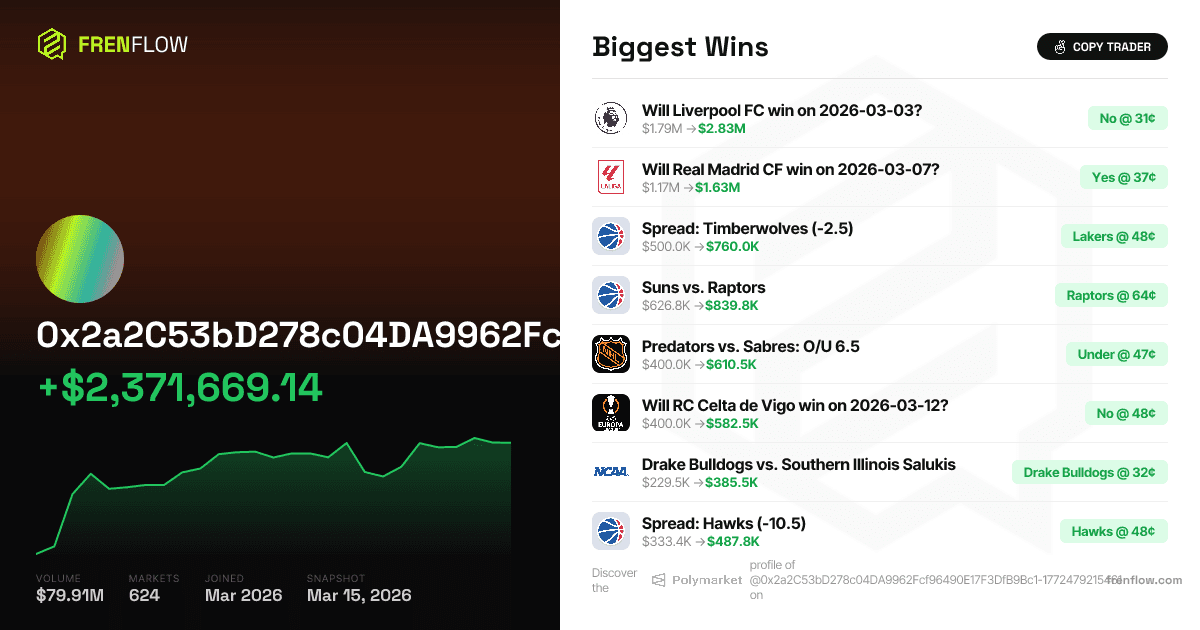
The trader operating under the pseudonym Dishonest-Bloom appeared on Polymarket in early March 2026 and immediately started deploying six- and seven-figure positions on sports outcomes — soccer, basketball, hockey, esports, spreads, over/unders. By March 14, the account had churned through $73.6 million in total volume and sat at #2 on the weekly leaderboard with $2.4 million in PnL. The 50-0 win-loss record isn't a typo. It's the most statistically improbable debut in Polymarket's recent history, and the explanation likely isn't luck.
The thesis: Dishonest-Bloom is almost certainly a sophisticated sports betting operation using Polymarket as an execution venue for edges developed elsewhere — and the 50-0 record, far from being miraculous, is a natural consequence of a strategy that only enters markets where the mispricing is large enough to be nearly deterministic.
The Edge Is in the Entry Price
Forget the win streak for a moment. Look at where Dishonest-Bloom is buying.
The average entry price on winning trades is 45.0¢. That alone tells a story: this account systematically buys contracts that the market prices as near-coinflips or worse, then collects $1.00 when they resolve correctly. But the distribution of entries is what separates this from reckless gambling.
| Trade | Entry Price | Profit | ROI | What It Implies |
|---|---|---|---|---|
| Liverpool FC "No" win (Mar 3) | 31.2¢ | $1.04M | 187% | Market gave Liverpool ~69% to win; Dishonest-Bloom disagreed with conviction |
| Real Madrid "Yes" win (Mar 7) | 36.7¢ | $458K | 107% | Bought a 37¢ contract on one of Europe's top clubs — and sized it to $1.17M |
| RC Strasbourg "Yes" win (Mar 7) | 19.0¢ | $108K | 163% | 19¢ entry implies the market saw an 81% chance Strasbourg would lose; they won |
| Espanyol vs. Oviedo Under 2.5 | 30.0¢ | $118K | 233% | 70% implied probability of 3+ goals; the game stayed under |
| Drake Bulldogs moneyline | 32.0¢ | $156K | 213% | Bought a heavy underdog at 32¢ in mid-major college basketball |
The pattern: Dishonest-Bloom repeatedly identifies contracts priced between 19¢ and 53¢ where they believe the true probability is dramatically higher. The average ROI across the top 25 winning trades is approximately 120%. You don't sustain 120% average ROI across 50 trades by guessing. You sustain it by having a pricing model that is systematically more accurate than the Polymarket order book.
This is the signature of a quantitative sports bettor — someone running models on expected goals, player-level metrics, and line discrepancies across sportsbooks. Polymarket's sports markets, especially on European soccer and lower-profile basketball games, are thinner and less efficiently priced than Pinnacle or Betfair. That gap is Dishonest-Bloom's playing field.
The Sizing Is the Tell
Edge alone doesn't produce $6.72 million in twelve days. Sizing does.
Dishonest-Bloom's position sizing is breathtakingly aggressive. The Liverpool "No" trade alone involved $1.79 million in shares. The Real Madrid "Yes" trade: $1.17 million. These are not the positions of someone testing a strategy. This is an operation with deep capital reserves deploying with institutional-level conviction.
Consider the implied Kelly fraction. If Dishonest-Bloom believed Liverpool's true probability of winning on March 3 was, say, 55% (meaning "No" was worth ~45¢), the Kelly-optimal bet at a 31.2¢ entry would suggest a fractional Kelly stake around 30-40% of bankroll, depending on exact edge assumptions. Putting $1.79M into that single position implies either a bankroll well north of $5 million or an edge so large that the Kelly fraction approaches full-Kelly territory.
Full-Kelly betting is famously dangerous — the theoretical growth-rate maximizer, but with drawdown volatility that bankrupts most practitioners. The fact that Dishonest-Bloom has survived 50 consecutive full-conviction positions without a single loss suggests one of two things: (1) the edges are genuinely enormous, meaning Polymarket's sports books are badly mispriced relative to sharp sportsbook lines, or (2) we're witnessing the mother of all survivorship bias snapshots, and the first loss will be catastrophic given the sizing.
The current balance of $834K — compared to $6.72M in closed profits — hints that significant capital has already been withdrawn or redeployed. Money management awareness, at minimum, exists somewhere in this operation.
The Portfolio Today: Still Swinging
As of March 14, Dishonest-Bloom holds 15 open positions totaling roughly $1.3 million in exposure. The unrealized gains sum to approximately $186K, and the portfolio reveals a broadening of scope.
| Category | Positions | Total Exposure | Unrealized P&L |
|---|---|---|---|
| European Soccer | 5 | ~$856K | +$138K |
| NBA/NHL Spreads & O/U | 1 | ~$106K | +$2K |
| Counter-Strike (Esports) | 3 | ~$150K | +$10K |
| Bitcoin / Commodities | 4 | ~$171K | +$14K |
| UFC | 1 | ~$14K | +$490 |
The soccer positions remain the largest — a $574K position betting against Arsenal winning today at 27.5¢ (now at 35.5¢) is the biggest single open trade. Three European soccer positions have already resolved at 100¢, locking in another wave of profits.
But the Bitcoin and crude oil positions are the most interesting deviation. Dishonest-Bloom is betting "No" on Bitcoin dipping to $65,000 and $60,000 in March, while simultaneously betting "Yes" on Bitcoin reaching $75,000. This is a directional bet: Bitcoin stays range-bound or drifts higher. The sizing — $50K, $52K, $35K — is small relative to the sports positions. These look like opportunistic side bets, not the core strategy.
The crude oil positions ("No" on $110 and $140 by end of March) are similarly modest and similarly directional. Dishonest-Bloom sees these extreme scenarios as overpriced and is clipping what amounts to premium. Reasonable, but not where the real alpha lives.
What the 50-0 Record Actually Means
Let's be precise about what we're seeing and what we're not.
A 50-0 record with an average entry of 45¢ means that, across 50 trades, not a single contract resolved against this account. If the true edge on each trade averaged 10 percentage points (i.e., buying at 45¢ what was truly worth 55¢), the probability of going 50-0 would be approximately 0.55^50 = 0.000000000000013. Essentially zero.
But this framing is wrong. The question isn't whether a 55%-true-probability bettor could go 50-0. The question is whether someone who only enters positions where the true probability is 75-90%+ — despite market pricing of 30-50¢ — could go 50-0. If the average true probability of each Dishonest-Bloom pick was 85%, then 0.85^50 = 0.003, or roughly 1-in-300. Unlikely, but not impossible. And if the true edge was even larger — say 90% average — then 0.90^50 = 0.005, which with enough attempts across enough traders becomes almost expected.
The 233% ROI on the Espanyol under-2.5 trade (entry at 30¢) implies Dishonest-Bloom believed the under was worth significantly more than the 30¢ market price. La Liga under markets on Polymarket, with thin liquidity and casual pricing, can diverge substantially from Pinnacle closing lines. If Pinnacle had this under at 55-60%, Dishonest-Bloom was buying dollar bills for thirty cents.
This is the core thesis: the 50-0 record isn't evidence of prophetic ability. It's evidence that Polymarket's sports markets, particularly in European soccer and lower-profile American sports, remain inefficient enough for a sharp bettor with good models to achieve near-certain outcomes on a per-trade basis — at least at this scale and this moment in the market's maturation.
The Risks No One Mentions
The danger is equally real. Three specific vulnerabilities stand out.
First, liquidity destruction. Dishonest-Bloom is deploying million-dollar positions into markets that may have $2-3 million in total liquidity. At this size, the account isn't just taking edge — it's moving markets. The Liverpool trade involved $1.79 million in shares. If the book was thin, Dishonest-Bloom likely paid significant slippage to fill, meaning the stated entry of 31.2¢ may represent a volume-weighted average with worse fills at the margin. As the account grows, its own size becomes the enemy of its edge.
Second, model dependency. Every quantitative sports bettor is running on some form of model — expected goals for soccer, player-prop correlations for basketball, map-win probabilities for CS:GO. These models work until they don't. A single regime change — a key player injury not yet reflected in data feeds, a match-fixing scenario, a weather event — can produce a loss that, at Dishonest-Bloom's sizing, erases weeks of gains in a single resolution.
Third, platform risk. An anonymous account, twelve days old, with no bio, no linked social media, and zero profile views, churning $73.6 million in volume, sits in a regulatory gray zone. Polymarket has historically been cautious about accounts that resemble professional sportsbook operations using the platform for regulatory arbitrage. Whether this account faces scrutiny — or whether it's already operating within known parameters — is unknowable from the outside.
The 50-0 record will end. The question is whether the operation behind Dishonest-Bloom is built to survive the first loss — or whether, like so many full-Kelly practitioners before, one bad week unravels the entire edifice. Track the positions in real-time on FrenFlow and decide for yourself.
Frequently Asked Questions
How much profit has Dishonest-Bloom made on Polymarket?
As of March 14, 2026, the account shows $2.43M in total profit and $6.72M in closed winning trades, with $73.6M in total volume traded since joining the platform in early March 2026.
What is Dishonest-Bloom's win rate on Polymarket?
The account has a 100% win rate on closed positions: 50 wins and 0 losses. The average entry price on wins is 45.0¢, and the average ROI across top trades exceeds 120%.
What markets does Dishonest-Bloom trade on Polymarket?
The account focuses primarily on sports — European soccer (La Liga, Premier League, Ligue 1, Serie A, Bundesliga), NBA, NHL, college basketball, and Counter-Strike esports. Smaller positions exist in Bitcoin and crude oil markets.
Is Dishonest-Bloom's 50-0 record on Polymarket legitimate?
The record is verifiable on-chain through the trader's Polygonscan address. The unblemished record likely reflects systematic identification of large mispricings in Polymarket's sports markets rather than luck, though a sample of 50 trades is too small to rule out favorable variance entirely.
How much does Dishonest-Bloom bet per trade on Polymarket?
Position sizes range from approximately $14K (UFC) to $1.79M (Liverpool FC soccer). The median position among the top 25 trades is roughly $250K, indicating institutional-level capital deployment for a platform like Polymarket.

Related articles
blindStaking's $710K Week on Polymarket: Sports Betting at Scale
Mar 22, 2026
Substantial-Service's 50-0 Polymarket Run Hides a $15K Graveyard
Mar 20, 2026
Japan vs Venezuela WBC: Polymarket Prices an 88% Rout
Mar 15, 2026
 Start Copying Now