


Japan vs Venezuela WBC: Polymarket Prices an 88% Rout
A Million Dollars in a Day, and Nowhere Left to Go
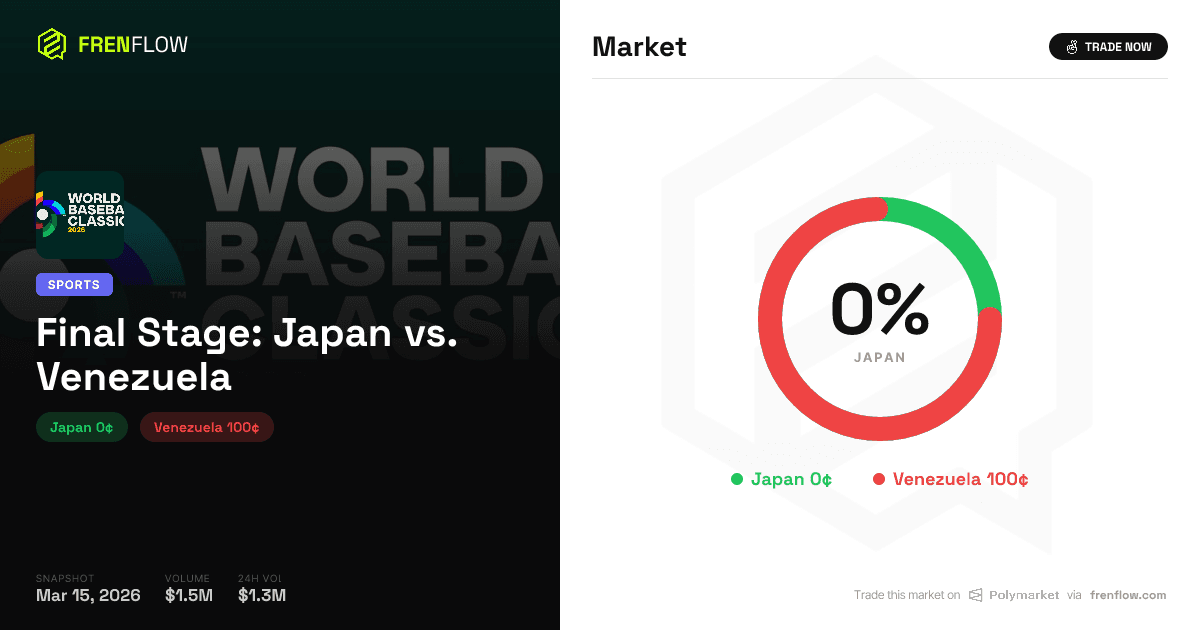
Polymarket traders dumped $1.09M into the Japan-Venezuela World Baseball Classic Final Stage matchup in a single 24-hour window — then the liquidity evaporated. Just $16,000 sits in the order book as of March 15, meaning anyone trying to take a meaningful new position would move the market by double digits. The price reads 88 cents Japan, 12 cents Venezuela, but that number is less a live market signal than a tombstone: it marks where conviction was at the moment the book dried up.
This is what happens when a prediction market meets a sporting event with a hard expiry. The game was scheduled for March 14 at 9:00 PM ET. By the time you read this on March 15, the outcome is almost certainly already determined — and the market's resolution window extends to March 22 to accommodate any administrative lag. The real analytical value here isn't in the final price. It's in what the market structure revealed before the result, and what it tells us about how sports betting markets on Polymarket actually function.
The +49% Move: Anatomy of a Price Surge
The headline trigger — a 49-cent move in 24 hours — demands context. A 49-point swing implies Japan's price climbed from somewhere around 39 cents to 88 cents, which translates from roughly a coin-flip assessment to near-certainty. That trajectory tells one of two stories:
- Pre-game repricing: The market opened thin and underpriced Japan (perhaps due to early liquidity providers setting wide spreads), and informed bettors — people who follow international baseball closely — rushed in to buy Japan at a discount once the market gained visibility.
- In-game live betting: If the game tipped off at 9:00 PM ET on March 14, a significant portion of the $1.09M in 24-hour volume may have arrived during the game itself, with traders bidding Japan up as the score unfolded.
The data leans toward a blend of both. Total all-time volume of $1.14M versus 24-hour volume of $1.09M means 96% of all money ever traded in this market arrived in the final day. This wasn't a market that built consensus over time. It was a flash event: created, discovered, traded, and drained in a single cycle.
| Metric | Value | Signal |
|---|---|---|
| Total Volume | $1.14M | Nearly all activity concentrated in one burst |
| 24h Volume | $1.09M | 96% of lifetime volume arrived in the final day |
| Current Liquidity | $16K | Book is effectively dead — price is a snapshot, not a signal |
| Japan Price | 88¢ | Implies 88% win probability |
| Venezuela Price | 12¢ | At 12¢, a $1,000 bet pays $8,333 on upset — 7.3x return |
| Market End Date | March 22 | Resolution buffer of 8 days after the scheduled match |
What $16K Liquidity Actually Means
Liquidity is the skeleton key to reading any prediction market, and $16,000 is microscopic. For comparison, major political markets on Polymarket routinely carry six- or seven-figure order books. Even mid-tier crypto markets hold $100K+ in resting liquidity.
At $16K, a single trader placing a $5,000 order on Venezuela would likely push that outcome's price from 12 cents to 25 cents or higher, depending on order book depth distribution. That doesn't mean Venezuela's real probability doubled — it means the market is no longer functioning as a price-discovery mechanism. It's a scoreboard.
This matters for anyone using Polymarket sports prices as inputs for modeling or arbitrage. An 88% print with $16K liquidity is categorically different from an 88% print with $2M liquidity. The first is a low-resolution estimate frozen by illiquidity. The second would represent deep, contested consensus. Treat them identically at your peril.
Japan's Dominance: Was 88% the Right Price?
Japan entered the 2026 World Baseball Classic as a perennial powerhouse. They won the inaugural 2006 tournament, repeated in 2009, and captured the 2023 edition in dramatic fashion. Their roster historically blends elite NPB talent with MLB stars — a combination that no other national team can replicate at quite the same depth.
Venezuela, while a legitimate baseball nation with deep MLB representation, has historically underperformed relative to its talent pool in WBC competition. The mismatch in tournament pedigree is real.
Traditional sportsbooks provide a useful benchmark. In major international baseball matchups featuring Japan against non-U.S., non-Dominican opponents, Japan typically prices as a -250 to -350 favorite depending on the stage, which translates to implied probabilities of 71–78%. Polymarket's 88% was higher than where most sportsbooks would have landed pre-game, which suggests one of several possibilities:
- Polymarket traders had access to lineup information, injury news, or bullpen usage data that traditional lines hadn't fully incorporated
- The price reflected in-game information (if much of the volume arrived after first pitch)
- Polymarket's thinner liquidity allowed informed bettors to push the price further than they could on Pinnacle or DraftKings, where order books are orders of magnitude deeper
The most likely explanation is the simplest: a significant chunk of volume arrived during or after the game. A 49-cent move in 24 hours on a single-game market is almost impossible to generate purely on pre-game sentiment shifts.
What This Market Reveals About Sports Betting on Polymarket
The Japan-Venezuela market is a case study in how Polymarket's sports markets operate differently from its political and crypto markets:
Speed of capital formation: Political markets build liquidity over weeks or months. This market went from zero to $1.14M in roughly 24–48 hours. Sports bettors are accustomed to rapid deployment — they move fast, bet big, and don't return once the event concludes.
Liquidity lifecycle: The $16K remaining tells us that market makers pulled their orders once the outcome became apparent (either through pre-game consensus or live-game scoring). In political markets, liquidity often increases as resolution approaches because uncertainty persists. In sports, uncertainty collapses in real-time, and liquidity follows it out the door.
Resolution mechanics: The market's end date of March 22 builds in an 8-day buffer after the March 14 game. This is conservative — most sports results are confirmed within minutes. But for a blockchain-based market requiring on-chain resolution, the buffer is prudent. Traders should note that capital remains locked until resolution, which creates an opportunity cost that doesn't exist on traditional sportsbooks where payouts are instant.
Volume concentration: 96% of volume in the final 24 hours means this market had almost no price-discovery phase. Compare that to, say, a presidential election market where the first $10M of volume establishes a baseline that the next $100M then refines. Sports markets on Polymarket skip the discovery phase entirely — they jump straight to conviction.
For those tracking sports market trends on FrenFlow, the pattern is consistent: single-event sports markets attract explosive volume bursts, achieve wide price spreads quickly, and go illiquid within hours of the event ending.
The Takeaway for Traders
If you're looking at Polymarket sports markets as a trading vehicle rather than a betting one, the structural lesson here is clear: the edge isn't in the final price. It's in being early to a mispriced open.
A market that opened Japan around 39 cents — if that's indeed where the +49% move began — was egregiously mispriced by any reasonable assessment of Japan's WBC strength. Anyone who bought Japan below 60 cents captured a risk-reward profile that was mathematically superior to anything available on traditional sportsbooks. The catch: you had to find the market, trust the resolution mechanism, and deploy capital within what was likely a window of just a few hours.
That's the Polymarket sports thesis in miniature. The inefficiencies are real but fleeting. Liquidity is thin enough to exploit but also thin enough to trap you. And the capital lockup through resolution day means your annualized return calculation has to account for dead time.
At 88 cents, Japan's position prices a near-certain outcome. At 12 cents, Venezuela offered a 7.3x return — but only if you believed Japan's true win probability was below 87%, and only if you could tolerate the binary risk of total loss. For a Final Stage WBC game featuring baseball's most successful international program, 12% for Venezuela may have been reasonable. Maybe even generous.
Frequently Asked Questions
What are the odds of Japan beating Venezuela in the 2026 World Baseball Classic on Polymarket?
As of March 15, 2026, Polymarket prices Japan at 88 cents (88% implied probability) to defeat Venezuela in their Final Stage matchup. Venezuela trades at 12 cents. The game was scheduled for March 14 at 9:00 PM ET, so these prices likely reflect in-game or post-game information rather than pure pre-game estimates.
How much money was bet on Japan vs Venezuela in the 2026 WBC?
Total volume reached $1.14M, with $1.09M of that arriving in the final 24 hours. This makes it one of the higher-volume single-game sports markets on Polymarket, though still small relative to major political markets on the platform.
When does the Japan vs Venezuela Polymarket bet resolve?
The market's resolution window extends to March 22, 2026. Resolution relies on official statistics from the WBC's governing body. If the game was played as scheduled on March 14, resolution should occur well before the March 22 deadline once official results are confirmed on-chain.
Was Japan favored to win the 2026 World Baseball Classic?
Japan entered the 2026 WBC as one of the tournament favorites, consistent with their historical dominance (multiple WBC titles). Polymarket's 88% pricing for this specific matchup against Venezuela reflected both Japan's overall tournament strength and likely real-time game information.
Can you still bet on Japan vs Venezuela WBC 2026 on Polymarket?
Technically the market remains open until March 22, but with only $16,000 in remaining liquidity, meaningful new positions would move the price dramatically. The market is effectively frozen — any remaining trading would be at highly unfavorable prices for both sides.

 Start Copying Now