

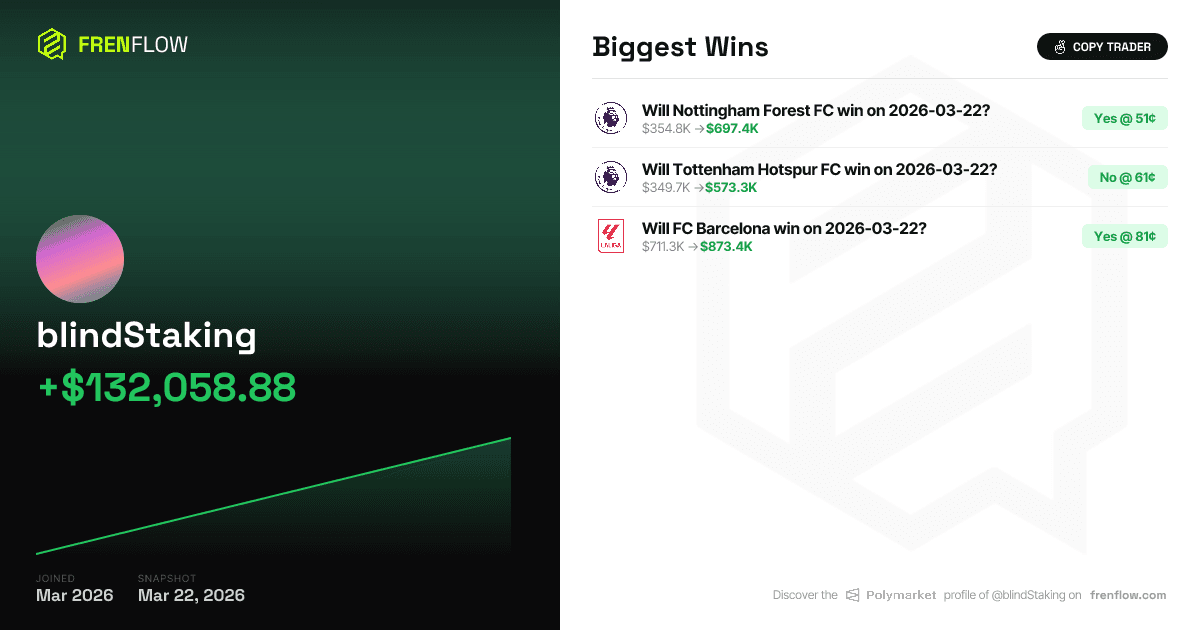
blindStaking's $710K Week on Polymarket: Sports Betting at Scale
Three Bets, Seven Days, $710K
$710,000 in profit from three positions, all entered and effectively won within a single week of account creation. The trader blindStaking joined Polymarket in March 2026, deployed over $2 million in capital across three football match markets, and — as of today, March 22 — sits on unrealized gains that represent a 33% return on total volume. No closed positions. No losses. No history. Just three large, correct bets on outcomes that have now moved to 100¢.
The surface story is simple: someone got three sports picks right. The deeper story is more interesting — and more instructive for anyone trading prediction markets at scale. blindStaking's positions reveal a deliberate strategy of harvesting pricing inefficiency in short-duration sports markets, deploying capital at sizes that dwarf typical Polymarket sports liquidity. The question isn't whether this trader got lucky. The question is whether Polymarket's sports markets are systematically mispriced, and whether blindStaking is the first large player to exploit it.
The Three Positions: Anatomy of a Playbook
All three of blindStaking's markets resolve on March 22, 2026 — today. Each involves a major European football club. Each position is now at 100¢, meaning the outcomes have occurred or are effectively settled. Here's what the portfolio looks like:
| Market | Side | Entry Price | Shares Held | Unrealized P&L | Implied Edge at Entry |
|---|---|---|---|---|---|
| Nottingham Forest win (Mar 22) | Yes | 50.8¢ | $698K | +$343K | ~49% underpriced vs. outcome |
| Tottenham Hotspur win (Mar 22) | No | 61.0¢ | $574K | +$224K | Bet against Spurs winning at 39¢ implied |
| FC Barcelona win (Mar 22) | Yes | 81.4¢ | $874K | +$162K | ~19% underpriced vs. outcome |
Three patterns jump out immediately.
First, the sizing is enormous. $698K in shares on a single Premier League match-day market is not retail behavior. Polymarket's daily-match football markets typically carry thin order books — a few thousand dollars of depth on each side. Moving $500K-$800K through these books without catastrophic slippage requires either patience (scaling in over hours) or coordination with liquidity providers. blindStaking's $2.15M total volume across three markets suggests this account either brought its own liquidity or found existing depth that most participants don't realize is there.
Second, the entry prices reveal selective aggression. The Nottingham Forest position was entered at 50.8¢ — essentially a coin flip in the market's estimation. Betting $698K that Forest would win at even-money odds implies either strong conviction from an external model or knowledge that the market was wildly mispricing the match. The Barcelona position, entered at 81.4¢, was far more conservative — a heavy favorite where blindStaking paid up for near-certainty but still captured 19 cents of edge per share on $874K of exposure. The Tottenham "No" at 61¢ sits in between: a bet that Spurs would fail to win, entered at a price implying 39% chance of a Tottenham victory.
These aren't random picks. The portfolio blends one high-conviction contrarian bet (Forest), one consensus-heavy confirmation bet (Barcelona), and one moderately contrarian fade (Tottenham). That's diversification across conviction levels, not just across matches.
Third, every position resolved the same day. There's zero overnight risk. Zero exposure to multi-day narrative shifts. blindStaking entered positions on markets expiring within hours or days, captured mispricing, and let time compress to zero. This is the sports-market equivalent of selling options into expiration — maximum theta, minimum duration.
The Pricing Inefficiency Thesis
Here's the argument that makes blindStaking's week more signal than noise: Polymarket's single-match sports markets are structurally inefficient, and anyone with a calibrated probability model and sufficient capital can harvest that inefficiency at scale.
Why would these markets be mispriced? Several reasons compound.
Polymarket's sports markets attract recreational bettors — crypto-native users who treat match-day markets like parlays, not probability instruments. Unlike pinnacled sportsbook lines, which reflect billions of dollars in global liquidity and the sharpest handicapping models on Earth, Polymarket match lines reflect a thin pool of mostly retail order flow. The price discovery mechanism is weaker.
Additionally, Polymarket operates on Polygon — a blockchain with low transaction costs but also low institutional adoption for sports betting. The sportsbook arbitrage community, which aggressively exploits line discrepancies across Bet365, Pinnacle, and DraftKings, largely hasn't arrived on Polymarket yet. That leaves a gap between the "true" line (available on any odds comparison site) and the Polymarket price.
blindStaking's entry on the Nottingham Forest match illustrates this perfectly. If external sportsbooks had Forest at, say, 60-65% implied probability to win, buying Yes at 50.8¢ on Polymarket represents 10-14 cents of pure edge per dollar of exposure. On $698K of shares, that's $70K-$98K of expected value before the match even kicks off. The actual profit was $343K because the full 49.2 cents per share paid out — but the expected edge at entry is what matters for evaluating whether this is skill or variance.
The Barcelona position tells a complementary story. Buying at 81.4¢ when major sportsbooks likely had Barcelona at 85-90%+ implied probability is a tighter edge — maybe 4-9 cents — but on massive size ($874K in shares). The expected value is lower per dollar, but the win probability is higher. It's a portfolio construction choice: anchor with high-probability positions, then swing on the mispriced underdog-turned-fair-value play.
What the Data Doesn't Show
Intellectual honesty demands flagging the limits of this analysis.
Sample size is three. Three bets, three wins. The probability of going 3-for-3 on independent events priced at 50.8%, 39% (No side of Tottenham), and 81.4% is roughly 0.508 × 0.61 × 0.814 = 25.2%. One in four. That's not a miracle — it's a plausible outcome under pure randomness with no edge whatsoever. We cannot distinguish skill from luck on three observations.
No closed positions exist. Every position is still technically open (though at 100¢). We don't know blindStaking's exit discipline because there hasn't been a loss to test it. The hardest part of large-scale sports betting isn't winning — it's managing drawdowns when a string of correct-in-expectation bets lose to variance. This trader has not yet faced that test.
The account is days old. Created in March 2026, with no prior history. This could be a new wallet for an experienced trader rotating funds — a common practice among Polymarket whales who prefer operational anonymity. Or it could be a first-time entrant whose beginner's luck is about to become a case study in survivorship bias. The data doesn't discriminate.
We don't know the funding source. The current balance is $2.14M. The total volume is $2.15M. This means nearly all the capital deployed remains in the account — profits haven't been withdrawn, and the initial bankroll was substantial. Whoever funds blindStaking treats seven-figure sports exposure as routine.
The Bigger Picture: Are Polymarket Sports Markets Broken?
blindStaking's week-one results are a data point in a growing pattern. Polymarket's political and crypto markets — the platform's bread and butter — attract sharp money and benefit from intense public scrutiny that aids price discovery. The U.S. election markets in 2024 and 2025 tightened to within a few cents of polling aggregates because thousands of motivated traders competed on information.
Sports match-day markets have no such ecosystem. They're new, lightly traded, and disconnected from the vast infrastructure of traditional sports betting. A trader who can pull real-time odds from Pinnacle, convert them to probability, and execute on Polymarket's order book faster than the market reprices has a durable edge — not because they're smarter, but because they're the first arbitrageur in the room.
If blindStaking continues this pattern — entering at prices demonstrably softer than sportsbook-implied lines, sizing aggressively, and targeting same-day resolution to minimize holding risk — the 33% return on volume will compress over time as more capital follows. But until that competition arrives, the edge may persist.
The alternative reading: this is a sophisticated bettor from traditional sports gambling who recognized that Polymarket's blockchain-based settlement creates a unique opportunity. No KYC friction for large bets. No account limits. No "winning too much" suspensions that plague sharp bettors on centralized sportsbooks. For someone whose Pinnacle account is already limited, Polymarket's permissionless structure isn't just convenient — it's the only venue that will still take their action at size.
What to Watch Next
blindStaking's next moves will reveal whether this is a strategy or a moment. If the account goes quiet after collecting $710K, this was likely an opportunistic strike — perhaps someone who spotted a mispricing, hit it hard, and moved on. If new positions appear in next weekend's match-day markets, at similar sizing and with entry prices consistently below sportsbook-implied lines, we're looking at a systematic operation.
The data available on FrenFlow's trader profile will update as positions close and new ones open. For now, what we have is a proof of concept: seven-figure capital can enter Polymarket's sports markets, find double-digit percentage-point mispricings, and extract six-figure profits in under a week. Whether that says more about blindStaking's skill or Polymarket's growing pains is the question that matters.
Frequently Asked Questions
How much has blindStaking made on Polymarket?
As of March 22, 2026, blindStaking has $710K in unrealized profit across three open positions, all of which have moved to 100¢ (indicating the predicted outcomes occurred). The trader's total volume is $2.15M, yielding a 33.1% profit margin. No positions have been formally closed yet, so this figure represents mark-to-market gains rather than realized profit.
What markets does blindStaking trade on Polymarket?
blindStaking has traded exclusively in single-match football (soccer) betting markets — specifically daily win/loss markets for Nottingham Forest, Tottenham Hotspur, and FC Barcelona, all resolving on March 22, 2026. The account has not traded political, crypto, or entertainment markets.
Is blindStaking's Polymarket profit from skill or luck?
With only three positions, statistical analysis cannot distinguish skill from luck. Going 3-for-3 on bets with these implied probabilities has roughly a 25% chance of occurring randomly. However, the entry prices — particularly the Nottingham Forest Yes at 50.8¢ — suggest the trader may have been exploiting pricing gaps between Polymarket and traditional sportsbook odds, which would indicate systematic edge rather than chance.
How does blindStaking bet so much on single Polymarket sports markets?
blindStaking deployed $574K to $874K per position, which is extraordinary for Polymarket's typically thin sports order books. This likely required either gradual accumulation over hours to avoid moving the price, direct negotiation with market makers, or access to liquidity not visible on the public order book. The account's $2.14M balance indicates a well-capitalized operation comfortable with seven-figure sports exposure.
When did blindStaking join Polymarket?
The account was created in March 2026. Given that all three positions were entered and effectively won within the same week, blindStaking's entire trading history spans approximately seven days as of this writing.

Related articles
Substantial-Service's 50-0 Polymarket Run Hides a $15K Graveyard
Mar 20, 2026
Japan vs Venezuela WBC: Polymarket Prices an 88% Rout
Mar 15, 2026
CemeterySun: 50-0 on Polymarket with $3.37M in Closed Wins
Mar 15, 2026
 Start Copying Now