

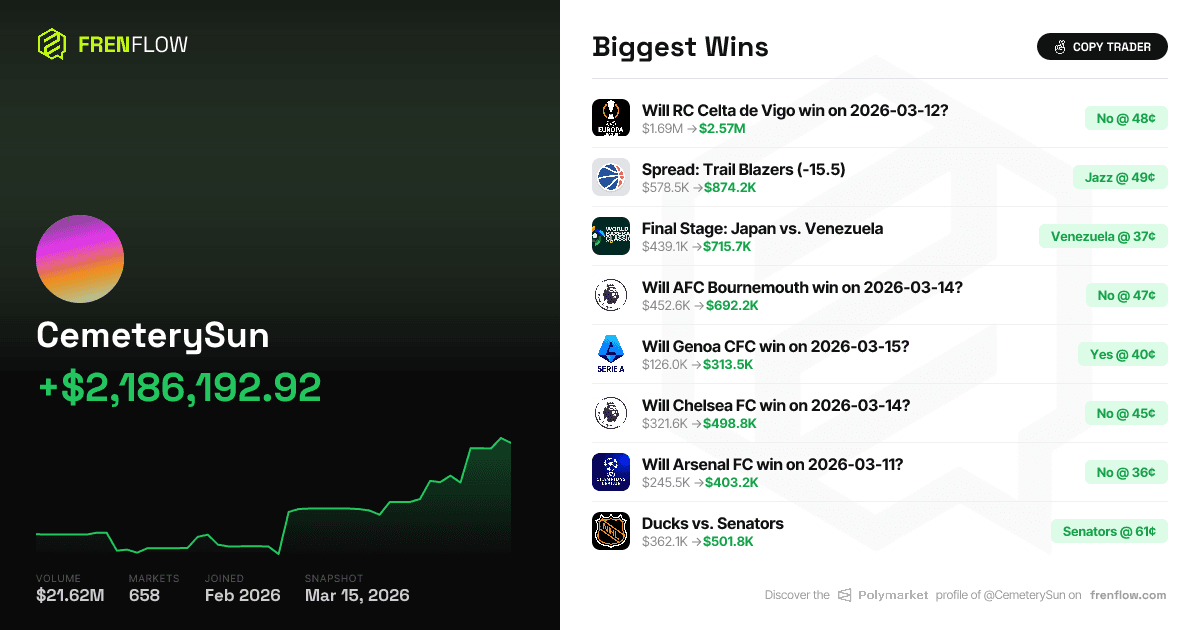
CemeterySun: 50-0 on Polymarket with $3.37M in Closed Wins
Fifty Trades, Zero Losses, and the Math That Should Make You Nervous
CemeterySun has closed 50 positions on Polymarket and won every single one, banking $3.37M in profit from $18M in volume since joining in February 2026. The account is six weeks old. It has no bio, no linked Twitter, and no public identity beyond the pseudonym "Pale-Bend." What it does have is a $2.5M current balance, 15 open positions trending profitable, and a statistical pattern so clean it demands a specific explanation — because luck isn't one.
The trigger for this analysis: $854K in profit in a single 24-hour window on March 14-15. That figure alone would rank among the largest single-day gains by any Polymarket trader this year. But the day's haul isn't the story. The story is in the entry prices, the market selection, and what the 50-0 record actually reveals about how this account operates.
The Entry Price Signature
Across all 50 closed winning trades, CemeterySun's average entry price is 50.1¢. That number is almost comically precise — essentially a coin flip. But the individual entries tell a sharper tale.
Consider the distribution:
| Entry Price Range | Notable Trades | Avg ROI | Interpretation |
|---|---|---|---|
| 30¢–40¢ | Capitals @ 33¢, Blackhawks @ 32¢, Arsenal No @ 35.8¢ | ~198% | Deep value — contrarian bets on heavy underdogs or against strong favorites |
| 40¢–55¢ | Celta No @ 47.9¢, Jazz spread @ 48.9¢, Bournemouth No @ 47.1¢ | ~104% | The core strategy — near-50/50 markets with massive position sizes |
| 55¢–73¢ | Chelsea No @ 72.3¢, Bologna No @ 70.1¢, Barcelona No @ 59.3¢ | ~55% | Lower ROI but higher implied conviction — betting "No" against favored European clubs |
The largest positions cluster in the 45¢–55¢ band. The Celta de Vigo trade — $1.69M in shares bought at 47.9¢, yielding $879K profit — represents nearly a quarter of total closed profit from a single bet. CemeterySun bought "No" on Celta winning, meaning the market priced Celta as slight favorites. The bet paid 108.9% ROI.
This isn't a trader buying heavy favorites at 85¢ and collecting pennies. This is someone consistently identifying near-even markets where the actual probability skews meaningfully to one side — then deploying six and sometimes seven figures of capital against the mispricing.
A Sports Arbitrage Machine Disguised as a Prediction Trader
The portfolio reads like a sportsbook blotter. NBA spreads, NHL moneylines, Premier League match outcomes, La Liga results, UFC prelims, MLS — CemeterySun trades across every major sport and league available on Polymarket. The 560 markets traded in six weeks averages roughly 13 new markets per day.
But the sport diversification isn't the edge. The edge is in which side CemeterySun takes.
Of the 25 largest winning trades by profit, 10 are explicit "No" bets on whether a specific team will win. Another 10 are spread bets or moneyline picks favoring the less-favored side. Only a handful — PSG Yes at 46.9¢, Raptors at 62.4¢ — back the consensus favorite, and even those were priced as near-toss-ups or mild favorites on Polymarket.
The pattern: CemeterySun systematically bets against the side that Polymarket's sports bettors have overvalued. In traditional sports betting, this is called "fading the public." The strategy exploits a well-documented bias: recreational bettors overweight favorites, big-name teams, and overs. Polymarket's sports markets — newer, less liquid, and populated by crypto-native traders rather than experienced sports bettors — likely amplify this bias.
The Arsenal trade crystallizes the approach. On March 11, Polymarket priced Arsenal's probability of winning at roughly 64% (implied from the "No" entry at 35.8¢). CemeterySun bought $246K worth of "No" shares. Arsenal didn't win. Profit: $158K at 179.5% ROI. The market was likely mispricing Arsenal's win probability because Polymarket participants — many of whom follow the Premier League casually — anchored on Arsenal's reputation rather than match-specific form, opponent quality, or lineup information.
Position Sizing: Conviction at Industrial Scale
The concentration risk in this portfolio would make most risk managers reach for antacids.
The Celta de Vigo trade alone — $1.69M in shares — represented a notional exposure that, at 47.9¢ per share, required roughly $809K in capital deployed on a single Spanish football match. That's a bet where a Celta win would have wiped out more than half the account's total realized profit at the time.
| Trade | Capital Deployed (est.) | % of Current Balance | Outcome |
|---|---|---|---|
| Celta de Vigo No | ~$809K | 32% | Won +$879K |
| Trail Blazers spread | ~$283K | 11% | Won +$296K |
| Bournemouth No | ~$213K | 9% | Won +$240K |
| Chelsea No (open) | ~$145K | 6% | Unrealized +$177K |
| Senators ML (open) | ~$222K | 9% | Unrealized +$140K |
The top three closed trades alone required an estimated $1.3M in capital. And CemeterySun isn't hedging — there's no evidence of offsetting positions or portfolio-level risk mitigation across the data. Each trade is a directional, binary bet with total loss as one possible outcome.
At 50-0, the Kelly criterion is technically undefined — an infinite edge implies infinite optimal bet size, which is obviously absurd and signals that the true win rate, applied forward, will be lower than 100%. Even a trader with a genuine 70% hit rate and 2:1 payoffs should Kelly-size at roughly 55% of bankroll per bet. CemeterySun's sizing on the Celta trade approached that threshold against a balance that likely sat between $2M and $3M at the time. The strategy is maximally aggressive by any framework.
The Fragility Beneath the Perfection
Here is the tension at the heart of the 50-0 record: the strategy appears to carry real, repeatable edge, but the position sizing means that edge needs to persist with near-perfection to avoid catastrophic drawdowns.
Consider the base rates. A trader genuinely skilled at identifying 5-10 cent mispricings in sports markets — buying at 48¢ what should be priced at 55¢ — might sustain a 60-65% win rate over hundreds of trades. At that rate, a 50-0 opening streak is astronomically unlikely (0.65^50 ≈ 0.000013%). So either CemeterySun's true edge is far larger than 60-65%, the account is benefiting from an extraordinary run of variance, or something structural — such as trading on delayed lines or information available from other sportsbooks — is compressing the variance.
The third option seems most plausible. Traditional sportsbooks employ armies of line-makers who adjust odds in real-time based on injury reports, lineup confirmations, and sharp money. Polymarket's sports markets are thinner, update slower, and rely on a smaller pool of informed participants to correct prices. A trader cross-referencing Pinnacle or Bet365 lines against Polymarket prices could systematically identify stale odds and exploit them before correction.
This would explain several features of CemeterySun's record: the near-50¢ average entry (targeting lines that have moved on sportsbooks but not yet on Polymarket), the massive position sizes (high confidence from seeing a confirmed edge), the cross-sport diversification (the strategy is market-structure dependent, not sport dependent), and the perfect record (the edge is structural rather than predictive, reducing variance).
If this diagnosis is correct, CemeterySun's real risk isn't a bad pick — it's Polymarket's sports markets becoming more efficient. As volume grows and more sophisticated participants enter, the window between sportsbook line movements and Polymarket price adjustments will narrow. The account's edge has a half-life.
What $854K in a Day Actually Means
The March 14-15 haul of $854K came from a cluster of simultaneously resolving positions: the Bournemouth "No" ($240K), Chelsea "No" (an open position now at 100¢ worth $177K unrealized), the Senators NHL moneyline ($140K unrealized), the UFC Anders fight ($134K unrealized), and several smaller NBA and European football bets.
This concentration of resolution dates reveals the operational tempo. CemeterySun doesn't hold positions for weeks — the average holding period appears to be 1-4 days, matching the cadence of sporting events. Capital recycles rapidly: win, collect, redeploy. At $18M in volume over approximately 42 days, the account turns over its entire balance roughly once every six days.
The open positions as of today show the machine still running. Fifteen active bets spanning NHL (Hurricanes-Lightning, Avalanche-Jets), NBA (Nuggets-Lakers spread, Nets-76ers totals), European football (Manchester City, Valencia, Real Madrid, Columbus Crew), and UFC. Twelve of the fifteen are already in profit. Total unrealized gains sit at approximately $716K.
If the current open positions resolve at rates consistent with the closed book, CemeterySun's total profit will exceed $4M within days — from an account that didn't exist seven weeks ago.
The Question the Data Can't Answer
The profile has zero listed trade count despite 560 markets traded and 50 closed positions — a data inconsistency that may reflect how FrenFlow counts versus how positions are opened through limit orders or API activity. The zero profile views suggest this account has operated entirely under the radar until now.
No Twitter. No bio. No public identity. The pseudonym "Pale-Bend" offers nothing. The wallet at 0x37c1...c53a could belong to an individual, a trading desk, or an automated system. The cross-sport, cross-league, multi-timezone coverage — European morning football through late-night American hockey — suggests either a team or a bot that doesn't sleep.
What is clear from the data: this is not a recreational trader who got lucky. The systematic targeting of near-50¢ markets, the industrial position sizes, the cross-referencing implied by sport diversification, and the zero-loss record across 50 resolved positions point to an operation extracting structural inefficiency from Polymarket's youngest and least-efficient market category.
The 50-0 streak will end. The question is whether the edge that built it survives the market's evolution — or whether CemeterySun has already extracted the bulk of what these markets had to give.
Frequently Asked Questions
How much profit has CemeterySun made on Polymarket?
As of March 15, 2026, CemeterySun has realized $1.42M in total profit according to platform data, with $3.37M in profit from 50 closed winning positions and zero losses. The account also holds approximately $716K in unrealized gains across 15 open positions and maintains a $2.5M current balance.
What is CemeterySun's win rate on Polymarket?
CemeterySun has closed 50 positions with 50 wins and zero losses — a 100% win rate on resolved trades. This record spans NBA, NHL, Premier League, La Liga, Serie A, MLS, and UFC markets over approximately six weeks of trading since the account was created in February 2026.
What sports does CemeterySun bet on?
The account trades across virtually every major sport available on Polymarket: NBA spreads and totals, NHL moneylines, Premier League and La Liga match outcomes, Serie A spreads, MLS results, and UFC fight picks. The strategy appears sport-agnostic, focusing instead on structural mispricings between Polymarket odds and traditional sportsbook lines.
How does CemeterySun choose which side to bet on?
Analysis of the 50 closed trades shows CemeterySun predominantly bets against teams that Polymarket's market has overvalued — buying "No" on favored teams or taking underdogs on spreads. The average entry price of 50.1¢ suggests the account targets markets priced as near-coin-flips where the true probability meaningfully favors one side.
Is CemeterySun's Polymarket streak sustainable?
A 50-0 record is statistically unsustainable under any realistic long-term win probability. Even at a 70% true win rate, the odds of 50 consecutive wins are approximately 0.0013%. The streak likely reflects a structural edge — potentially cross-referencing sportsbook lines against slower-moving Polymarket prices — that compresses but does not eliminate variance. As Polymarket's sports markets attract more sophisticated participants, this edge is expected to narrow.

 Start Copying Now