
Warsh at 94¢ Looks Like a Lock. The DOJ Probe Says Otherwise.
The 6-Cent Question Wall Street Should Be Asking
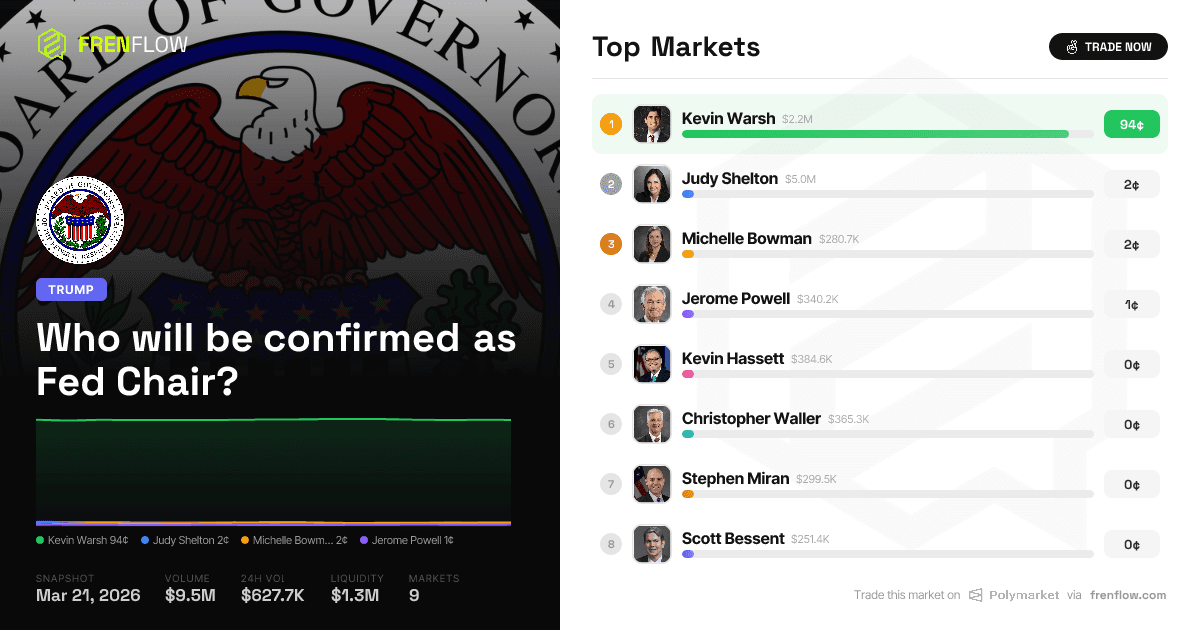
Judy Shelton has generated $5.02M in volume on this market — more than double Kevin Warsh's $2.23M — yet she trades at just 1.9¢. That volume-to-price ratio screams a market that has already processed and rejected a major alternative. But the more consequential signal sits at the top of the board: Warsh commands 94.2% implied probability, and the market just printed $628K in 24-hour volume, suggesting active repositioning even at near-certainty prices. The question for traders isn't whether Warsh gets confirmed. It's whether 94¢ adequately compensates for the compounding risks between here and the October 31 resolution deadline — risks that, as of this week, just got materially worse.
Powell's statement on March 18 confirmed what the market structure already suspected: the Fed Chair transition is stuck. No Senate hearing has been scheduled for Warsh. A DOJ criminal investigation targeting Powell himself has created a procedural blockade, with Republican Senator Thom Tillis refusing to advance Warsh's confirmation until the probe is resolved. And a federal judge's decision to quash DOJ subpoenas against Powell — now under appeal — means the legal limbo could persist for months. The Polymarket event resolves to "Other" if no confirmation occurs by December 31, 2026. That deadline suddenly looks less like a formality and more like a live outcome.
The Blockade: Why 94¢ Misprices Tail Risk
The confirmation pathway for Warsh requires clearing three sequential obstacles, each of which currently has no defined timeline:
-
The DOJ probe must resolve (or Tillis must relent). Senator Tillis has explicitly conditioned his cooperation on the investigation concluding. The probe targets Powell and the Fed — its scope and duration are controlled by DOJ, not the White House. Appeals of the quashed subpoenas could take months.
-
The Senate Banking Committee must schedule and hold a hearing. As of March 21, no hearing date exists. Even under favorable conditions, committee logistics, witness preparation, and the Senate calendar impose weeks of lead time.
-
The full Senate must vote to confirm. With a narrow Republican majority, any defection or procedural delay (including holds by individual senators) could push this further out.
Powell's term as Chair expires May 15, 2026 — 55 days from today. He has committed to staying on past that date, which is legally permitted under the Federal Reserve Act. But his continued tenure creates an unusual dynamic: the longer the vacancy persists, the more political pressure builds on both sides, and the more likely an alternative scenario (withdrawal of Warsh's nomination, a recess appointment attempt that wouldn't resolve this market, or a different nominee entirely) becomes.
| Risk Factor | Current Status | Impact on Timeline |
|---|---|---|
| DOJ investigation of Powell/Fed | Active; subpoena appeal pending | Could delay months |
| Sen. Tillis hold on confirmation | Explicitly blocking until probe ends | Binary gate |
| Senate Banking Committee hearing | Not yet scheduled | Minimum 3-4 weeks after scheduling |
| Powell's Chair term expiration | May 15, 2026 | Powell stays on — no forcing function |
| Market resolution deadline | December 31, 2026 | "Other" if no confirmation by then |
The cascade of dependencies means the 5.8% implied probability of "not Warsh" (the sum of all other outcomes) may be thin. But the structural logic cuts the other way too: a confirmation delay past year-end, while unlikely, isn't a 0.1% tail event when a sitting senator is actively blocking the process and a DOJ appeal has no statutory deadline.
Volume Forensics: What $5M in Shelton Volume Actually Tells Us
The most telling feature of this market isn't the Warsh price — it's where the speculative capital went. Judy Shelton attracted $5.02M in volume on a contract now trading at 1.9¢. That's over half the market's total $9.52M volume concentrated in a long-shot that has been beaten down to near-zero.
This pattern is diagnostic. Shelton was a prior Trump nominee for the Fed Board of Governors whose nomination was withdrawn after failing to secure Senate confirmation in 2020. Her reappearance as a speculative favorite suggests the early trading reflected a bet on Trump's heterodox instincts — a hypothesis the market has since firmly rejected after Trump announced Warsh in January. The volume is a fossil record of a thesis that died.
Michelle Bowman at 2.4¢ ($281K volume) is the most interesting remaining alternative. As a sitting Fed Governor, she would require a different kind of political lift, but her position within the Fed makes her a plausible contingency if Warsh's confirmation collapses entirely. Rick Rieder at 0.3¢ with $350K in volume reflects a bet on Trump pivoting to a Wall Street outsider — a scenario that requires Warsh's withdrawal, not just delay.
The volume distribution tells a clear story: the market has decisively consolidated around Warsh, but the alternatives that retain any volume share a common thesis — that the confirmation process breaks down entirely.
Pricing the "Other" Scenario
Here's where the math gets interesting for contrarian traders. "Other" currently trades at effectively 0¢ — the market assigns zero probability to no confirmation occurring by December 31. But consider the scenario:
- The DOJ appeal drags through summer 2026
- Tillis maintains his hold
- The Senate Banking Committee cannot schedule a hearing
- Trump, frustrated, attempts a recess appointment (which this market explicitly excludes)
- No formal Senate confirmation vote occurs before December 31
Is that probability truly zero? The market's resolution rules are specific: only a formal Senate confirmation of the Chair position counts. Recess appointments don't qualify. Confirmation as a Board Governor alone doesn't qualify. The resolution source is the U.S. Senate.
A trader who believes the combined probability of "confirmation blocked through year-end" or "Trump withdraws Warsh and nominates someone late enough that confirmation slips past December" exceeds 2-3% has a defined-risk opportunity. At 0¢, the "Other" contract is effectively free to acquire for anyone with this thesis.
The problem is liquidity. With $1.32M total across the book and most of it concentrated in Warsh, moving any alternative contract meaningfully requires patience. This is a market where you build positions over days, not hours.
What the Fed Meeting Just Changed
The March 18 Fed meeting injected two new pieces of information into this market:
First, Powell explicitly committed to staying through the DOJ probe and until a successor is confirmed. This removes any urgency from the White House's perspective — there's no vacancy to fill, just a chair they'd prefer to replace. The political calculus shifts when there's no crisis. Powell's willingness to stay indefinitely means the cost of delay, to the administration, is not a headless Fed but rather continued Powell leadership. For a president who has publicly clashed with Powell on rate policy, that's an irritant but not an emergency.
Second, the Fed held rates steady despite Powell acknowledging inflation "isn't coming down as much as hoped." This monetary policy tension gives both sides of the confirmation fight ammunition. Hawks can argue Warsh would be tougher on inflation. Doves can argue the transition itself creates destabilizing uncertainty. Neither framing accelerates the confirmation timeline.
The $628K in 24-hour volume on this market — the largest daily flow in recent weeks, based on the market's 17-day age — likely reflects traders processing these developments. Most of that volume probably reinforced the Warsh position (buying at 94¢ for a 6.2% return by year-end isn't irrational if you believe confirmation is a matter of when, not if). But some of it may represent informed traders accumulating cheap No exposure on the thesis that the Tillis blockade has real teeth.
The Trade: Warsh Yes vs. Calendar Risk
For a data-driven framework on FrenFlow, consider the expected value:
Warsh Yes at 94.2¢: Pays $1.00 on confirmation. That's a 6.2% return with a maximum holding period of ~9.4 months (through October 31 resolution). Annualized, that's roughly 7.9% — competitive with risk-free rates but carrying genuine binary risk. If you assign 95%+ probability to confirmation by December 31, this is a reasonable parking spot for capital.
Warsh No (or any alternative) at combined 5.8¢: Pays $1.00 if Warsh is not confirmed as Chair. That's a 17.2x return. The question is whether the real probability exceeds 5.8%. Given the DOJ appeal timeline, the Tillis blockade, and no scheduled hearing 55 days before Powell's term expires, a case exists that the true probability of "not Warsh by December 31" sits closer to 8-12%. At that range, the expected value favors the No side.
| Position | Entry Price | Max Payout | Required Probability for +EV | Key Risk |
|---|---|---|---|---|
| Warsh Yes | 94.2¢ | $1.00 | >94.2% | DOJ probe extends; Tillis holds |
| Warsh No (via alternatives) | ~5.8¢ combined | $1.00 | >5.8% | Confirmation proceeds despite blockade |
| "Other" | ~0¢ | $1.00 | >0% (essentially free) | Requires total confirmation failure |
The asymmetry matters. Being wrong on Warsh Yes costs you 94.2¢ per share. Being wrong on any individual No contract costs you 0.3-2.4¢. The risk/reward for small speculative positions on the No side is far more forgiving.
The Verdict
The market is probably right that Kevin Warsh becomes the next confirmed Fed Chair. Trump nominated him. He has prior Fed experience as a governor. And even with the Tillis blockade, political dynamics in the Senate tend to resolve — especially within the president's own party.
But 94.2% prices a world where the DOJ probe resolves cleanly, Tillis lifts his hold, and the Senate machinery processes a confirmation hearing and vote within the next nine months. Each of those steps has genuine uncertainty. The market is treating a multi-step political process like a single-step event.
For most traders, the actionable insight isn't to fade Warsh. It's to recognize that the 5-6¢ available across alternatives represents an unusually cheap option on political chaos — and in 2026, political chaos is not exactly a tail scenario. The next catalyst to watch: any movement on the DOJ appeal, which controls the Tillis gate, which controls the hearing schedule, which controls everything.
Frequently Asked Questions
Who is Trump's nominee for Fed Chair in 2026?
Donald Trump announced in January 2026 that he would nominate Kevin Warsh, a former Federal Reserve governor, to replace Jerome Powell as Fed Chair. As of March 21, 2026, the Senate has not yet scheduled a confirmation hearing.
Why hasn't Kevin Warsh been confirmed as Fed Chair yet?
Warsh's confirmation has been blocked by a combination of factors: a DOJ criminal investigation involving Powell and the Fed, Senator Thom Tillis's explicit refusal to advance the nomination until the probe concludes, and the absence of a scheduled Senate Banking Committee hearing.
What are the odds Kevin Warsh becomes Fed Chair on Polymarket?
As of March 21, 2026, Polymarket prices Kevin Warsh at 94.2% implied probability to be confirmed as the next Fed Chair. The market has attracted $9.52M in total volume. Alternative candidates like Michelle Bowman (2.4%) and Judy Shelton (1.9%) trade at long-shot prices.
Will Jerome Powell remain Fed Chair after May 2026?
Powell stated on March 18, 2026, that he will remain as Fed Chair until his successor is formally confirmed by the Senate, even if that extends beyond his term expiration on May 15, 2026. This is consistent with the Federal Reserve Act's provisions for holdover service.
When is the deadline for the Fed Chair confirmation market on Polymarket?
The market resolves to "Other" if no Senate confirmation of a Fed Chair has occurred by December 31, 2026, at 11:59 PM ET. Only formal Senate confirmation counts — recess appointments or Board of Governors confirmations alone do not qualify.

 Start Copying Now