
Iran War End: Polymarket Prices Surge on Trump Ceasefire Talks
The Five-Day Window That Repriced a War
Hours after Trump posted his all-caps Truth Social declaration—ordering the "Department of War" to postpone strikes on Iranian power plants for five days pending negotiations—$778K in fresh volume crashed into Polymarket's Iran war timeline market. That single-day surge represents 15% of the market's entire $5.07M lifetime volume, generated in response to a diplomatic signal that is, by the president's own framing, conditional and reversible. The market didn't interpret the announcement as a ceasefire. It interpreted it as the opening of a negotiation whose timeline extends far beyond the five-day pause ending around March 28.
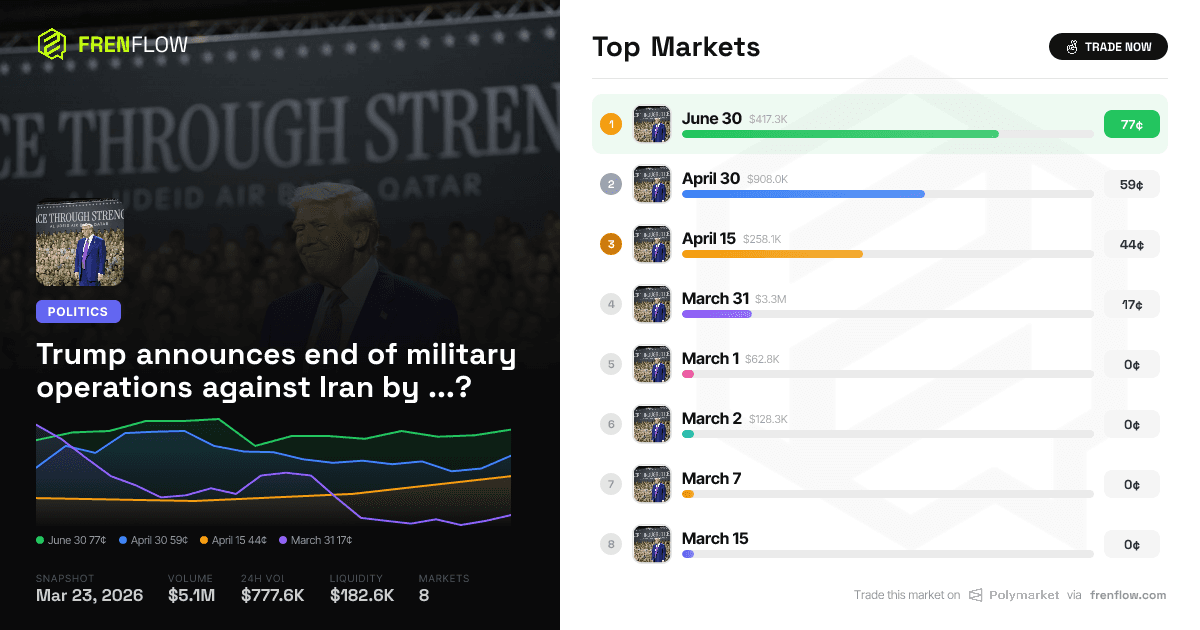
Here's the tell: the March 31 contract, which would require a formal end-of-operations announcement within eight days of today, trades at just 16.5 cents—despite being the highest-volume contract in the entire market at $3.30M. That isn't conviction that the war ends this month. That's the graveyard of earlier optimism, dollars placed weeks ago when traders bet on a shorter conflict, now sitting at a fraction of their entry price. The real money thesis lives further out the curve.
The Term Structure: What Each Date Implies
The market offers contracts on eight specific resolution dates, and the price curve tells a coherent story about how traders model escalation, negotiation, and presidential deal-making rhythm.
| Deadline | Price | Implied Probability | Volume | Signal |
|---|---|---|---|---|
| March 1 | 0.0¢ | 0% | $63K | Expired worthless—war did not end in 24 hours |
| March 2 | 0.0¢ | 0% | $128K | Same; early optimism burned |
| March 7 | 0.0¢ | 0% | $0 | Zero interest—no one expected a week-long war |
| March 15 | 0.0¢ | 0% | $0 | Also expired; conflict passed the two-week mark |
| March 31 | 16.5¢ | 16.5% | $3.30M | Heavy legacy volume, low current conviction |
| April 15 | 44.0¢ | 44.0% | $258K | The swing contract—where the action shifts next |
| April 30 | 58.5¢ | 58.5% | $908K | Market's center of gravity |
| June 30 | 77.0¢ | 77.0% | $417K | "Eventually, yes"—but not a strong bet at 77¢ |
The first four contracts are dead—resolved or effectively worthless. The war that began February 28 has now lasted 23 days. The active trading frontier is March 31 through June 30, and the prices sketch a clear arc: roughly one-in-six chance the war ends this month, coin-flip odds for mid-April, and nearly three-in-four for an end by summer.
But look at the volume distribution. March 31 absorbed $3.30M—65% of all dollars ever traded in this market—yet sits at 16.5 cents. That means the vast majority of Yes buyers on that contract are underwater. At current prices, a $1,000 position on March 31 Yes pays $6,060 if correct. That's a 6x return in eight days. The market is saying Trump's five-day pause is far more likely to collapse than to produce a formal end-of-hostilities announcement by month's end.
Why March 31 at 16.5% Is Probably Still Too High
Let's map the real-world timeline against the resolution criteria. The market requires an official, public announcement that military operations have concluded. Trump's Truth Social post today explicitly does not do this—it postpones strikes on energy infrastructure for five days "subject to the success of the ongoing meetings and discussions." Multiple conditions remain unmet:
The Strait of Hormuz demand. Multiple reports confirm Trump's core demand is that Iran reopen the Strait of Hormuz to all shipping. Iran's blockade of this chokepoint—through which roughly 20% of global oil transits—is the economic lever that makes this conflict globally consequential. Reopening the strait requires Iran to withdraw naval assets, de-mine potential areas, and provide verifiable security guarantees. That process, even with goodwill on both sides, takes more than eight days.
The nuclear dimension. While the market's resolution criteria focus solely on the end of military operations, the broader negotiation almost certainly involves Iran's nuclear program. The Wikipedia entry on the 2026 Iran war references the sustained degradation of Iran's ballistic missile capacity through early March. Any comprehensive deal—the kind Trump would frame as a historic victory—likely bundles denuclearization commitments with a cessation of hostilities. Bundled deals take longer.
The "subject to success" caveat. Trump's own language makes the pause conditional. If talks falter by March 28, strikes resume. A failed negotiation round would likely push the timeline to mid-April at the earliest, as the U.S. would need to execute additional strikes before returning to the table with more leverage.
For March 31 Yes to resolve, you need: productive talks this week, a formal agreement framework by ~March 27, and an official announcement within days. Possible, but the 16.5% price already captures this thin-path scenario generously.
April 15 Is the Pivotal Contract
The most analytically interesting contract is April 15 at 44 cents, with only $258K in volume. Here's why it deserves more attention than it's getting.
If Trump's five-day pause produces a framework agreement—even a conditional one—the market should reprice April 15 sharply upward. A framework announced by late March, followed by a two-week implementation period (Hormuz reopening, ceasefire verification, prisoner exchanges or other confidence-building measures), could plausibly produce a formal end-of-operations announcement by April 15.
Conversely, if the pause collapses and strikes resume on Iranian energy infrastructure, April 15 plummets. The market is pricing this contract almost exactly at a coin flip, which suggests deep uncertainty about whether the current diplomatic window is real or theatrical.
At 44 cents, a $1,000 Yes position returns $2,273 if correct—a 127% gain over 23 days, or roughly 2,000% annualized. The question is whether today's diplomatic signals warrant a probability above 44%. My read: Trump's public framing—all caps, triumphant tone, "complete and total resolution"—suggests he wants a deal, and this president's pattern is to declare victory and move on. The fact that he's publicly invested in the success of these talks increases the probability he finds a way to announce an end to operations, even if the underlying security situation remains ambiguous. I'd put fair value for April 15 closer to 50-55%, which means the current price offers a modest edge for Yes buyers—though with substantial binary risk.
Liquidity Is Dangerously Thin
The number that should concern every trader in this market: $184K in total liquidity across all contracts. For a market with $5.07M in cumulative volume tracking an active U.S. military conflict, that liquidity figure is startlingly low. It means that a single $50K order could move prices by several cents on any individual contract.
This has practical implications. The $778K in 24-hour volume likely caused significant slippage—traders reacting to the Trump announcement were competing for limited liquidity on the bid side of No contracts and the ask side of Yes contracts. Anyone trying to take a large position in April 15 or April 30 is facing a market that can gap against them on the next headline.
The liquidity drought also means that prices are less reliable as probability estimates than they would be in deeper markets. The 58.5% on April 30, for instance, might reflect the views of a handful of large holders rather than broad consensus. On FrenFlow's event page, you can track how liquidity distributes across contracts—a useful exercise before sizing any position.
The Scenario Tree From Here
Three paths dominate the probability space as of this evening:
Scenario 1: Deal by early April (probability: ~20%). The five-day pause produces a framework. Iran agrees to reopen the Strait of Hormuz. Trump declares victory. Operations formally end by late March or the first week of April. March 31 resolves Yes (or narrowly misses), April 15 and all later contracts resolve Yes. This is the path the market rallied on today.
Scenario 2: Extended negotiation, resolution by May (probability: ~40%). Talks continue but stumble on nuclear terms or verification mechanisms. Limited strikes resume, then another pause. A deal emerges in late April after additional pressure. April 30 resolves Yes. This is the modal outcome implied by current prices.
Scenario 3: Talks collapse, war escalates or freezes (probability: ~25-30%). Negotiations fail. Strikes on Iranian energy infrastructure proceed. Iran retaliates. The conflict becomes a sustained low-intensity campaign that extends past June 30. All contracts resolve No. The 23 cents of implied "No" probability on the June 30 contract captures this tail risk—and given the history of Middle Eastern military engagements outlasting initial timelines, 23% might be too low.
A residual ~10% covers exotic outcomes: a deal that technically doesn't meet the market's resolution criteria (informal ceasefire without a formal announcement), or a dramatic escalation that reshapes the entire conflict.
The Bottom Line
The market's message is clear: Trump's ceasefire signal is real enough to price, but not decisive enough to bet on a rapid conclusion. The $3.30M trapped in the March 31 contract represents the cost of earlier optimism about a quick conflict. Today's diplomatic turn has repriced the April and June contracts meaningfully upward, but the thin liquidity means these prices are fragile—one hawkish Pentagon briefing or Iranian provocation could erase today's gains overnight.
The sharpest edge, if it exists, is in April 15 at 44 cents. Trump's personal investment in these talks, his pattern of declaring wins, and the economic pressure on both sides to resolve the Hormuz standoff all argue for a probability north of 50%. But this is a binary bet on geopolitical negotiation with a known liar's-poker dynamic—both sides have incentives to posture, stall, and misrepresent progress. Size accordingly.
Frequently Asked Questions
What are the odds the Iran war ends by April on Polymarket?
As of March 23, 2026, Polymarket prices imply a 16.5% chance of a formal end-of-operations announcement by March 31, a 44% chance by April 15, and a 58.5% chance by April 30. These probabilities shifted significantly higher today after Trump announced a five-day pause on strikes against Iranian energy infrastructure.
Did Trump announce an end to the Iran war?
Not yet. On March 23, 2026, Trump announced via Truth Social that the U.S. and Iran had engaged in "very good and productive conversations" and ordered a five-day postponement of strikes on Iranian power plants and energy infrastructure. This is a pause, not a formal end to military operations. The market requires an official announcement that operations have concluded.
When did the U.S. military operations against Iran start?
U.S. military operations against Iran began on February 28, 2026. As of March 23, the conflict has lasted 23 days. The operations have included strikes against Iranian military and, more recently, threatened strikes against energy infrastructure. Iran's blockade of the Strait of Hormuz has been a central point of contention.
How much money has been bet on the Iran war ending on Polymarket?
Total volume in the Iran war timeline market stands at $5.07M, with $778K traded in the 24 hours following Trump's five-day strike pause announcement. The March 31 deadline contract alone has attracted $3.30M in volume, though most of those positions are significantly underwater at the current 16.5-cent price.
What would it take for the Iran war to end by March 31?
For the March 31 contract to resolve Yes, the five-day negotiation window (ending around March 28) would need to produce a comprehensive agreement, and Trump or the U.S. government would need to make an official public announcement that military operations have concluded—all within eight days. The market prices this at 16.5%, reflecting the narrow path required.

 Start Copying Now