


Wizards-Celtics Polymarket: Why $1M Bet a 5% Underdog
The $1M Question Nobody's Asking
Of the $2.86M wagered on tonight's Wizards-Celtics game, $1.07M — 37% of total volume — sits on the moneyline. Not the spread. Not the over/under. The moneyline, where Washington trades at 5.3 cents on the dollar. That means for every dollar of expected return the moneyline market implies, traders have committed roughly $57 in capital. Compare that to the spread markets, where $1.16M spreads across four different lines in a genuinely contested coin-flip zone. The moneyline isn't where the information is. It's where the action is. And in prediction markets, the gap between those two things tells you everything.
The thesis: this market's +27% surge and $1.1M in 24-hour volume aren't driven by a credible reassessment of Washington's chances. They're driven by the peculiar economics of long-shot NBA moneylines on Polymarket — where the payoff structure attracts capital that has nothing to do with basketball analysis.
Anatomy of a 20-Point Spread
Boston is favored by roughly 20 points tonight. The spread markets tell the story cleanly:
| Market | Price | Implied Prob. | Volume | Signal |
|---|---|---|---|---|
| Spread -19.5 | 52.5¢ | 52.5% | $321K | Slight lean Boston covers |
| Spread -20.5 | 48.5¢ | 48.5% | $100K | Market split at 20.5 |
| Wizards ML | 5.3¢ | 5.3% | $1.07M | Volume dwarfs all spreads |
| 1H Spread -11.5 | 50.0¢ | 50.0% | $37 | Dead — no conviction |
The spread markets bracket the true line somewhere between 19.5 and 20.5 points. That's a historically massive NBA spread — the kind typically reserved for a tanking team visiting a title contender. The 52.5% implied probability on -19.5 against 48.5% on -20.5 suggests the market's best estimate is right around Boston -20. That's consistent with what traditional sportsbooks would price for a matchup between a team likely in the bottom three of the league and the defending-caliber Celtics.
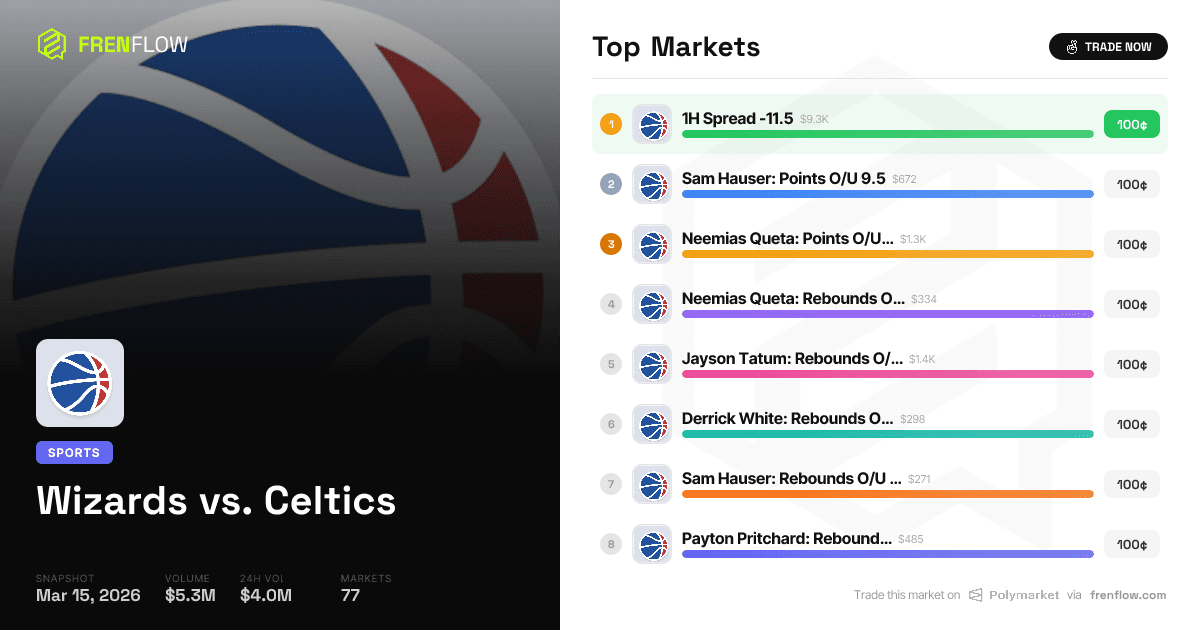
The first-half spread at -11.5 has attracted exactly $37. Thirty-seven dollars. That's not a market; that's a rounding error. It tells us that the prop-level markets on this game are essentially decorative. The real capital has polarized: serious spread bettors are in the -19.5/-20.5 range, and everyone else piled into the moneyline.
The Moneyline Magnet: Why Long Shots Attract Disproportionate Volume
A $100 bet on the Wizards moneyline at 5.3¢ pays $1,887 if Washington wins outright. That's an 18.9x return. The lottery-ticket math is irresistible for a certain class of bettor, and the data confirms it: $1.07M flowed to a market that, by the market's own pricing, has a 94.7% chance of resolving to zero.
Let's do the expected value calculation. If Washington's true win probability is 5.3%, a $100 Yes position has an expected value of exactly $100 — it's a fair bet by definition. But if the true probability is even slightly lower — say 4% — then every $100 wagered has an expected value of $75.47, a 24.5% haircut. At 3%, it drops to $56.60. The traders pouring money into this side need Washington's actual win probability to be at or above the market price just to break even.
The +27% price move — likely from somewhere around 4¢ to 5.3¢ — doesn't require a whale with inside information. It requires roughly $55K-$60K in net new buying pressure on a market with moderate liquidity. In a $1.45M liquidity pool spread across 40+ sub-markets, that kind of move is mechanical, not informational.
Where the Smart Money Actually Is
Strip away the moneyline noise, and the game's real analytical battleground is the total. Here, the volume distribution reveals genuine disagreement:
| Total Line | Over Price | Volume | Signal |
|---|---|---|---|
| O/U 227.5 | 64.0¢ | $15K | Strong over lean, thin |
| O/U 228.5 | 61.5¢ | $45K | Moderate over lean |
| O/U 229.5 | 58.5¢ | $459K | Heaviest volume — key line |
| O/U 230.5 | 56.5¢ | $84K | Still over-leaning |
| O/U 231.5 | 54.5¢ | $735K | Most-traded total line |
| O/U 232.5 | 52.0¢ | $7K | Near coin flip |
| O/U 233.5 | 49.0¢ | $18K | Slight under lean |
Two total lines dominate: 231.5 ($735K) and 229.5 ($459K). Together they account for $1.19M — 42% of total market volume. The pricing gradient is orderly: each half-point step down from 233.5 to 227.5 adds 2-3 cents of over probability. The implied "true total" sits right around 233, where the market flips from over-favored to under-favored.
The $735K on O/U 231.5 at 54.5¢ over is the most informed bet in this entire market structure. That's a line where the over is slightly favored but far from certain — exactly the kind of edge a quantitative model would identify. The expected margin is thin (54.5% vs. the 50% breakeven), but the volume is enormous relative to the moneyline's mindless action. Dollar-for-dollar, the total markets reveal far more about how the game is expected to unfold than the headline moneyline move.
Player Props: A Ghost Town With One Exception
The player prop markets are, with few exceptions, dead on arrival. Combined volume across all player props barely cracks $1,300. Most individual props show exactly $0 in volume — posted but untouched, like items on a menu nobody orders.
The exceptions are telling:
-
Trae Young Points O/U 13.5 at 28¢ over: $388 in volume. Young's presence in Washington's lineup, and the 13.5 line, suggests the market expects limited minutes or a blowout-shortened rotation. A 28% implied probability of going over 13.5 is strikingly low for a player of Young's caliber, potentially reflecting rest or minute restrictions in a lost-cause game.
-
Jaylen Brown Points O/U 25.5 at 28¢ over: $59 in volume. Same directional signal — the unders are heavily favored on Boston's stars, consistent with a blowout where starters sit the fourth quarter.
-
Jayson Tatum Points O/U 22.5 at 28¢ over: $25 in volume. Again, the market expects Boston's starters to coast.
The pattern is uniform: every major player's points prop prices the under heavily. This isn't a game the market expects to be competitive past halftime. The first-half moneyline for Washington at 13.5¢ — implying an 86.5% chance Boston leads at the half — reinforces this. Boston's dominance isn't expected to be a slow-building affair. It's priced as immediate.
What the +27% Move Actually Means
The trigger for this analysis — a 27% price surge on $1.1M in 24-hour volume — deserves contextualization. Nearly all of that volume ($2.85M of the $2.86M total) arrived in the last 24 hours, which makes sense: this market opened on March 9 but serious game-day liquidity only materializes close to tip-off.
The +27% move almost certainly refers to the Wizards moneyline, which likely opened around 4¢ and now trades at 5.3¢. In absolute terms, that's a 1.3-cent move. In percentage terms, it looks dramatic because the base is tiny. If the Celtics moneyline moved 1.3 cents — from, say, 94.7¢ to 96¢ — nobody would write about it. The asymmetry of percentage moves on extreme long shots makes them look like signals when they're often just noise.
Is there any scenario where this move reflects genuine information? Injury news could do it — if a key Celtics player were ruled out shortly before game time, the moneyline would reprice. But the spread markets haven't moved to reflect any such development. The -19.5/-20.5 lines remain stable and orderly. If Boston lost a star, you'd see the spread collapse to -14 or -15, and the moneyline would reprice far more aggressively than a penny and a half. The stability of the spread markets is the strongest evidence that the moneyline move is liquidity-driven, not information-driven.
Traders tracking this game's market structure in real-time can monitor the full range of sub-markets on FrenFlow, where the price-volume dynamics across spreads, totals, and props update live.
The Bottom Line
This market is functioning exactly as designed, but the headline number is misleading. The +27% move on Washington's moneyline represents lottery-ticket buying against a 20-point spread, not a credible reassessment of the game's outcome. The real action — $1.19M across the 229.5 and 231.5 total lines — points to a high-scoring blowout with a true total around 233. Player props universally price the under on stars' scoring lines, confirming expectations that starters on both sides will log reduced fourth-quarter minutes.
For traders: the moneyline is entertainment. The over/under 231.5 at 54.5¢ is where the informed volume concentrated. And the player prop markets, at near-zero liquidity, are essentially unpriced — meaning any sharp with a model could move them with pocket change.
Frequently Asked Questions
What are the odds of the Wizards beating the Celtics tonight on Polymarket?
The Wizards moneyline trades at 5.3¢, implying a 5.3% win probability. This is consistent with a roughly 20-point spread in Boston's favor. A $100 bet on Washington pays approximately $1,887 if they win outright.
Why did the Wizards-Celtics Polymarket odds spike 27%?
The +27% move reflects a shift from approximately 4¢ to 5.3¢ on Washington's moneyline — a 1.3-cent absolute move that looks dramatic in percentage terms because the starting price was so low. The spread markets, which are more liquid and informative, show no corresponding shift, suggesting the move is liquidity-driven rather than information-driven.
What is the Polymarket spread for Wizards vs Celtics March 14 2026?
The market brackets the spread between -19.5 (52.5% Boston covers) and -20.5 (48.5% Boston covers), implying a true line around Boston -20. The -19.5 line drew $321K in volume, making it the most liquid spread sub-market.
What is the over/under for Celtics-Wizards tonight?
The most-traded total line is O/U 231.5, with $735K in volume and over priced at 54.5¢. The pricing gradient across all total lines implies the market's best estimate of the true total is approximately 233 points.
Can you bet on NBA player props on Polymarket?
Yes — this game includes player props for points, rebounds, and assists for players including Jayson Tatum, Jaylen Brown, Trae Young, and Alexandre Sarr. However, liquidity on these props is extremely thin, with most showing zero or near-zero volume as of game day.

 Start Copying Now