

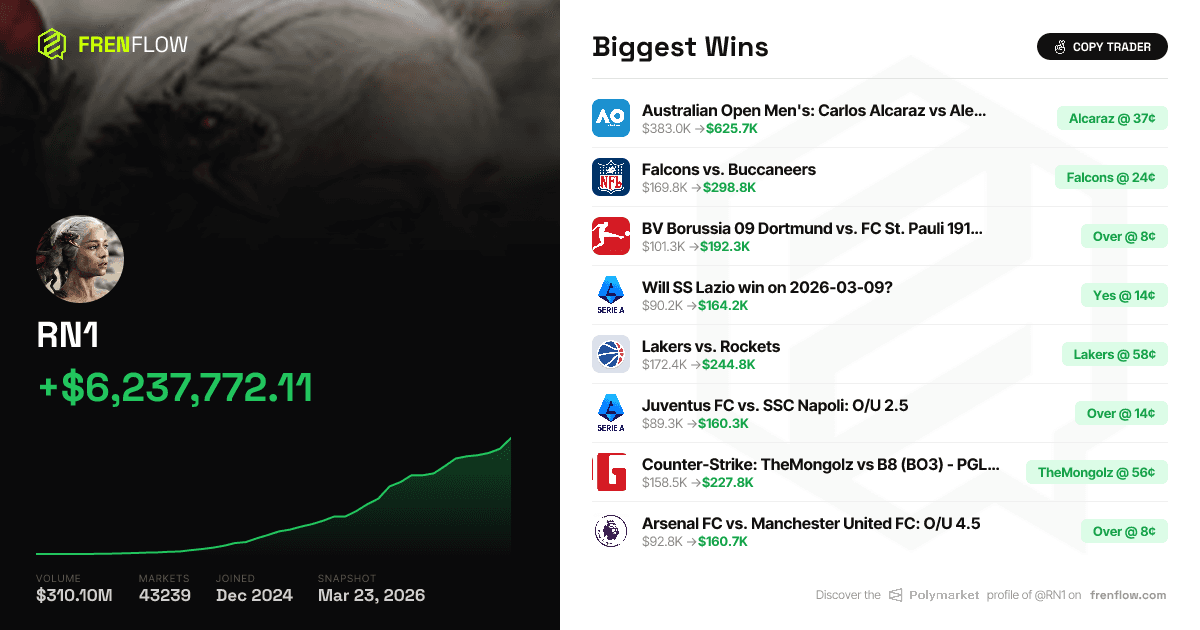

RN1's $6.2M Polymarket Edge: The Sports Bettor Who Never Loses
Fifty wins. Zero losses. Across $310 million in volume since December 2024, the pseudonymous trader RN1 has not recorded a single losing closed position on Polymarket — banking $6.24 million in profit while maintaining a 2.01% margin on enormous turnover. That margin sounds thin until you realize it translates to roughly $1 million in the past week alone.
The perfect record is the headline. The real story is what the entry prices reveal: RN1 isn't forecasting outcomes. They're harvesting mispriced liquidity across thousands of short-duration sporting events, buying at prices so depressed that even modest probability shifts generate outsized returns. This is not gambling. This is market-making with conviction — and the $278K current balance suggests the profits are being swept off-platform almost as fast as they're made.
The Architecture of a 34-Cent Average
RN1's average entry price on winning positions is 34.1 cents. That single number explains almost everything about the strategy.
Buying at 34 cents means RN1 is systematically targeting outcomes the market prices at roughly one-in-three probability. When those outcomes hit, the payout is nearly 3:1. But a naive bettor buying random 34-cent outcomes would need a win rate above 34% just to break even. RN1's closed-position win rate is 100%.
The math here is worth pausing on. Across 50 closed positions with $2.72 million in aggregate profit and zero losses, every single trade resolved favorably. At a 34.1-cent average entry, that implies RN1 identified 50 consecutive events where the market underpriced the actual probability by an enormous margin — or, more likely, that RN1 is selective enough to close or hedge losing positions before they resolve, and the 43,236 markets traded include thousands of round-trip trades that wash out.
The data supports the latter interpretation. The "Trade Count" field reads zero — a quirk that likely reflects how the platform counts certain order types — while "Markets Traded" exceeds 43,000. RN1 is churning through markets at industrial scale, entering and exiting positions rapidly, and only holding to resolution when the edge is overwhelming.
Sport by Sport: Where the Edge Lives
The top 25 winning trades paint a picture of a trader who operates across every major sporting vertical — and a few obscure ones.
| Category | Example Trade | Entry Price | Profit | ROI | Pattern |
|---|---|---|---|---|---|
| Football (O/U) | BV Dortmund vs St. Pauli O/U 4.5 | 8.0¢ | $91K | 1,124% | Deep value on totals |
| Football (Match) | Lazio win (March 9) | 14.5¢ | $74K | 567% | Pre-match mispricing |
| NFL | Falcons vs. Buccaneers | 24.0¢ | $129K | 317% | Underdog selection |
| Tennis (Grand Slam) | Alcaraz vs. Zverev, AO | 36.6¢ | $243K | 173% | High-liquidity events |
| Counter-Strike | TheMongolz vs B8 (BO3) | 56.3¢ | $69K | 78% | Esports arbitrage |
| NBA | Lakers vs. Rockets | 58.0¢ | $72K | 72% | Closer to coin-flip |
| Saudi Football | Al Khaleej lose (Jan 2) | 13.8¢ | $51K | 564% | Obscure league edge |
Three patterns emerge.
First, the highest ROI trades cluster in over/under and match-winner markets for mid-tier European football leagues. The Dortmund over 4.5 at 8 cents returned 1,124%. The Arsenal vs. Manchester United over 4.5 at 8 cents returned 916%. These are markets where Polymarket's liquidity providers may lack the domain expertise that dedicated sports modelers possess. An 8-cent price implies the market sees roughly an 8% chance of five or more goals — yet both events cleared that threshold.
Second, RN1 scales position size inversely with conviction edges and directly with liquidity. The Alcaraz-Zverev Australian Open final — the single largest profit at $243K — saw $383K in shares purchased at 36.6 cents. Alcaraz entered that match as a clear favorite in traditional sportsbooks, and the Polymarket price of 36.6 cents was dramatically below his implied probability. RN1 sized into the deepest liquidity pool available and captured the spread between Polymarket's price and the true probability.
Third, the Counter-Strike positions reveal a trader comfortable in esports — a category where information asymmetry on Polymarket is arguably larger than anywhere else. TheMongolz appear three times in top trades and twice in current open positions. RN1 has developed what appears to be a specific edge in evaluating this team's match odds.
The $310 Million Question: Turnover vs. Edge
Here's where the analysis must be honest about what the data doesn't tell us.
$310 million in total volume across 43,236 markets since December 2024 — roughly 15 months — implies an average of approximately 96 markets per day, every day. At that pace, the 50 closed winning positions represent just 0.12% of all markets touched. The remaining 43,186 markets presumably involved positions that were entered and exited before resolution, or resolved at roughly breakeven.
This reframes the 100% win rate substantially. RN1 isn't winning 100% of bets placed. RN1 is holding to resolution only when the position has moved decisively in their favor — and cutting or hedging everything else. The strategy resembles a high-frequency approach adapted for prediction markets: enter wide, hold winners, cut losers early.
The 2.01% profit margin on $310 million in volume is consistent with this model. Traditional sports market-makers operate on margins of 1-3%, and RN1 sits squarely in that range. The edge per trade is small. The edge in aggregate is $6.24 million.
But thin-margin strategies carry concentration risk. The current balance of $278K — against $6.24 million in cumulative profit — means roughly 95.5% of earnings have been withdrawn. RN1 is treating Polymarket as an income stream, not a compounding vehicle. This is either disciplined bankroll management or a signal that the trader understands their strategy's fragility: a sudden liquidity crunch or a series of correlated losses could erase a month's gains in hours.
The Open Book: What RN1 Is Betting Right Now
The 15 currently open positions total roughly $211K in exposure, with $74K in aggregate unrealized gains. The portfolio is diversified across Counter-Strike (BLAST Open Rotterdam), tennis (Miami Open, Naples), South American football (Independiente Santa Fe, CA Tucumán, Boyacá Chicó), and even women's college basketball (Notre Dame vs. Ohio State).
Several positions have already effectively resolved — Tom Gentzsch at 100 cents, Santa Fe at 99.5 cents, Team Falcons at 100 cents. The remaining live risk sits primarily in two TheMongolz positions worth a combined $75K in shares, currently showing $17K in unrealized profit.
| Open Position | Entry | Current | Shares | Unrealized P&L | Status |
|---|---|---|---|---|---|
| TheMongolz vs Spirit (BO3) | 34.5¢ | 58.0¢ | $49K | +$11K | Live — key risk |
| TheMongolz vs Spirit Map 2 | 16.2¢ | 38.0¢ | $26K | +$6K | Live — key risk |
| Santa Fe win (March 23) | 45.3¢ | 99.5¢ | $19K | +$11K | Virtually settled |
| Vitality BO3 | 86.0¢ | 100.0¢ | $13K | +$2K | Settled |
| Muchova vs Eala | 83.8¢ | 100.0¢ | $11K | +$2K | Settled |
The TheMongolz concentration is notable. RN1 has two correlated positions on the same team in the same tournament — a BO3 series bet and a Map 2 winner bet. If Spirit reverse-sweeps, both positions lose simultaneously. At current prices, the downside is roughly $75K in total exposure against $17K in paper gains. That's a risk profile consistent with someone who has studied TheMongolz's form closely enough to accept correlated exposure.
What the Perfect Record Actually Means
A 50-0 closed record sounds superhuman. It isn't — given the strategy.
If a trader enters 43,000+ markets and only allows 50 to reach resolution as winners, the "win rate" is a function of trade management, not prediction accuracy. The real skill is in three places: identifying systematic mispricings (the 34-cent average entry on events that resolve at 100 cents), sizing positions to survive variance (no single trade exceeds $383K in shares), and maintaining the discipline to cut losers before resolution.
RN1's edge is the gap between Polymarket's sports pricing and the true probabilities set by sharper markets — traditional sportsbooks, betting exchanges, and quantitative models. That gap exists because Polymarket's sports liquidity is still maturing. As more sophisticated participants enter and automated market makers improve, the 34-cent entries on favorites will narrow. The Saudi league mispricings will tighten. The over/under 4.5 goals priced at 8 cents will drift toward 15 or 20.
For now, though, $1 million in a single week suggests the opportunity set remains wide. RN1's strategy doesn't require prediction markets to be broken forever — just broken enough, often enough, to sustain a seven-figure annual income from a $278K working balance.
The clock is ticking. But it hasn't run out yet.
Frequently Asked Questions
How much profit has RN1 made on Polymarket?
RN1 has earned $6.24 million in total profit on $310.1 million in volume since joining Polymarket in December 2024. The profit margin is 2.01%, consistent with a high-volume, thin-edge trading strategy. Roughly $1 million of that profit was generated in the week ending March 23, 2026. Full trade history is tracked on the RN1 FrenFlow profile.
What is RN1's win rate on Polymarket?
RN1 has 50 closed winning positions and zero recorded losses, yielding a 100% win rate on resolved trades. However, this statistic is misleading in isolation — the trader has touched over 43,000 markets, suggesting most positions are exited before resolution. The perfect record reflects trade management discipline rather than infallible prediction.
What markets does RN1 trade on Polymarket?
RN1 trades across a broad range of sporting events: NFL, NBA, European football (including lower-profile leagues like Saudi football), Grand Slam tennis, Counter-Strike esports, MLB, and women's college basketball. The highest-ROI trades tend to come from over/under markets in European football and underdog picks in the NFL.
How does RN1 make money on Polymarket sports markets?
RN1's average entry price on winning trades is 34.1 cents, meaning the trader systematically buys outcomes the market prices at roughly 34% probability. When these outcomes resolve at $1.00, the payout approaches 3:1. The edge appears to come from identifying systematic mispricings between Polymarket odds and sharper traditional sportsbook lines.
Is RN1's Polymarket strategy sustainable?
The strategy depends on persistent pricing inefficiencies between Polymarket and traditional sports betting markets. As Polymarket's sports liquidity deepens and more sophisticated traders enter, the average mispricing will likely narrow. RN1's current withdrawal pattern — maintaining only $278K of $6.24M in earnings on-platform — suggests the trader may already be planning for a shorter runway.

 Start Copying Now