

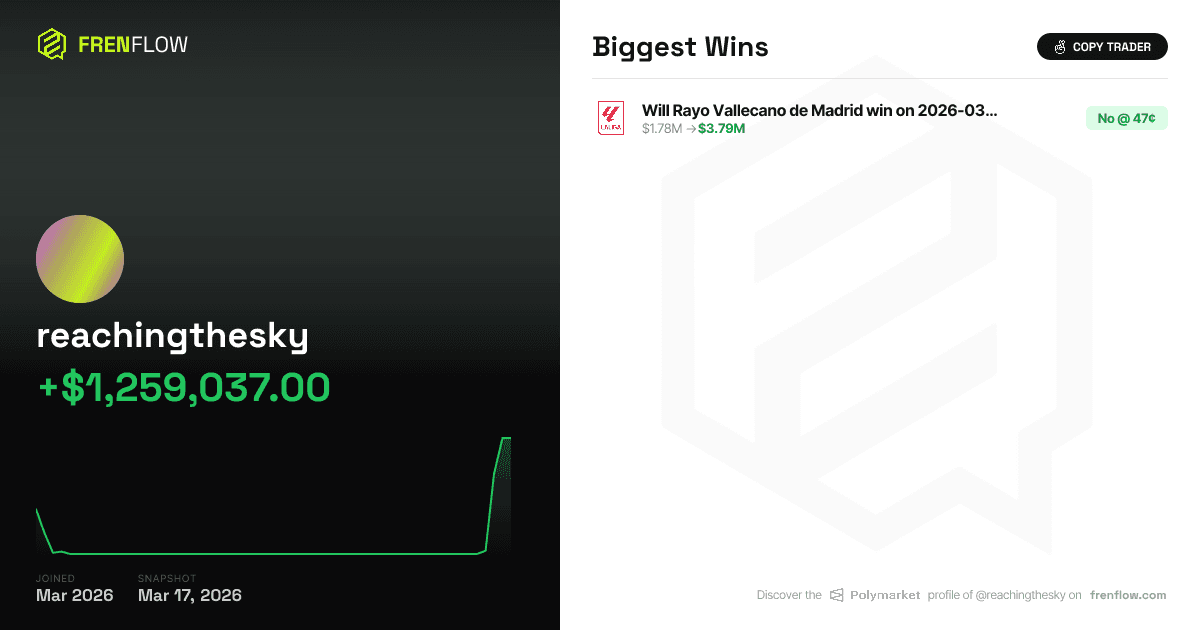
reachingthesky's $2M Day on Polymarket: Betting Against Football
A $2 Million Swing on a Sunday in Madrid
$2.01 million in unrealized profit from a single position — betting that Rayo Vallecano de Madrid would not win on March 16, 2026. That's the headline number for reachingthesky, a Polymarket account that didn't exist five weeks ago and now sits on a $3.79 million balance. But the headline obscures the full picture: two other football bets, both on the "No" side, both losers, totaling roughly $750K in unrealized losses. This isn't a diversified portfolio. It's three concentrated wagers on European football outcomes, and the variance could just as easily have run the other way.
The account has traded only three markets. Ever. Total volume: $5.53 million. Total profit: $1.26 million, representing a 22.77% return. Zero closed positions — meaning every dollar of that profit is still unrealized, sitting in open or recently resolved markets. The entire story of reachingthesky is written in three lines of a trade ledger, and those three lines tell us something uncomfortable about how prediction markets price sports risk.
The Portfolio: Three Bets, One Thesis
Strip away the platform mechanics and reachingthesky's strategy is transparent: buy "No" shares on football match outcomes where the implied probability of a team winning is moderate — then collect when the favorite fails to deliver.
| Market | Position | Entry Price | Current Price | Shares | Unrealized P&L | Status |
|---|---|---|---|---|---|---|
| Rayo Vallecano win 2026-03-16 | No | 47.0¢ | 100.0¢ | $3.79M | +$2.01M | Won ✅ |
| SSC Napoli win 2026-03-14 | No | 32.6¢ | 0.0¢ | $58K | −$19K | Lost ❌ |
| Eintracht Frankfurt win 2026-03-14 | No | 43.6¢ | 0.0¢ | $1.68M | −$731K | Lost ❌ |
The pattern: all three positions are "No" bets against favored (or semi-favored) teams. All three were entered within a roughly 48-hour window in mid-March. The entry prices — 47¢, 32.6¢, and 43.6¢ — suggest reachingthesky was buying "No" shares when the market implied the teams had roughly 53% to 67% chances of winning. When those "No" shares resolve at $1.00 because the team didn't win, the payout is enormous. When they resolve at $0.00 because the team did win, the loss is total.
This is binary sports betting dressed in prediction market mechanics. And on Sunday, it paid off — massively — on the Rayo Vallecano leg.
The Math Behind +$2M in One Day
Reachingthesky acquired approximately $3.79 million in "No" shares on the Rayo Vallecano match at an average entry of 47.0¢. Rayo Vallecano did not win. Those shares are now worth $1.00 each.
The math is straightforward: $3.79M × (1.00 − 0.47) = ~$2.01M in profit. That's a 113% return on deployed capital for a single match.
But the two losses are equally instructive. SSC Napoli did win on March 14, zeroing out a $58K position — a relatively small hit. Eintracht Frankfurt also won, destroying $1.68M in "No" shares bought at 43.6¢. The loss there: $731K. That's the cost of being wrong when you're concentrated.
Net across all three positions: +$2.01M − $19K − $731K = approximately +$1.26M. That matches the $1.26M total profit figure exactly. The 22.77% return on $5.53M in volume is entirely explained by winning one bet big enough to cover two losses.
What the Account Structure Reveals
Several features of this account demand scrutiny.
Age and velocity. The account was created in February 2026 — barely a month ago. Within weeks, it deployed over $5.5 million across three sports markets. This is not a trader learning the platform. Someone arrived with capital, conviction, and a specific thesis.
Zero closed positions. The profile shows 0 wins and 0 losses in closed trades because, as of the data snapshot, the positions haven't formally settled. The Rayo Vallecano "No" shares are at $1.00 (match resolved), but redemption may not have occurred yet. This matters: the $3.79M current balance likely reflects the value of those winning shares, not cashed-out USDC.
Concentration that defies conventional risk management. Allocating $3.79M to a single football match — even at "No" odds of 47¢ — implies a bankroll strategy with no meaningful position limits. If Rayo Vallecano had won, that $3.79M would be zero. The Frankfurt loss already demonstrates what happens when the coin lands the other way: $731K evaporated. At this concentration level, two consecutive wrong bets would annihilate the portfolio.
No social presence. No linked Twitter account. No bio. Zero profile views before this triggered analysis. This is either a privacy-conscious professional or an account designed to execute a specific set of trades and move on.
The Edge Question: Sports Arbitrage or Informed Gambling?
The central question: does reachingthesky have an edge, or did they get lucky on the biggest of three bets?
With a sample of three trades, statistical inference is impossible. A 1-for-3 record (in terms of trades that went the right direction) with a positive P&L only because the winning position was larger than the two losers combined — that's not a track record. It's an anecdote.
But the entry prices are worth examining. Buying "No" on Rayo Vallecano at 47¢ implies the market priced Rayo's win probability at ~53%. If reachingthesky believed the true probability was lower — say, 40% — then the expected value of the "No" share was 60¢, purchased at 47¢, yielding +13¢ of edge per share. Scale that across $3.79M in shares and the expected profit is substantial even before knowing the outcome.
Similarly, buying "No" on Eintracht Frankfurt at 43.6¢ implied the market priced Frankfurt's win at ~56%. If the true probability was higher — and Frankfurt did win — then this wasn't a bad-luck loss. It was a mispriced bet.
The deeper question is whether Polymarket's football markets are efficient enough to resist this kind of capital. Football match markets on prediction platforms are notoriously thin compared to traditional sports books. A trader with sharp odds from European betting exchanges — where football liquidity is orders of magnitude deeper — could theoretically exploit Polymarket's less efficient pricing. Buy "No" shares on Polymarket where the implied odds are softer than Betfair or Pinnacle, and you're arbitraging between two markets.
The data doesn't confirm this. But the pattern — large capital, fast deployment, sports-only, "No"-side bias — is consistent with someone who has access to sharper lines elsewhere and is using Polymarket as the soft side of a cross-platform play.
What Comes Next for reachingthesky
Three trades do not make a strategy legible. The $1.26M profit is real, but it rests on a single correct call about a mid-table La Liga club on a Sunday afternoon. The losses on Napoli and Frankfurt show this approach can bleed fast when the underlying thesis is wrong.
The critical variable is whether reachingthesky continues trading. If this account deposits more capital and repeats the pattern — large "No" positions on European football — then we're watching someone who believes they've found a persistent inefficiency in Polymarket's sports pricing. If the account goes dormant after collecting the Rayo Vallecano payout, it was likely a one-shot play: exploit a specific mispricing, extract the profit, disappear.
Either way, the account exposes a structural reality of prediction markets in 2026. When a single wallet can move $3.79 million into one football match and swing $2 million in a day, the question isn't whether prediction markets are efficient — it's whether they have enough liquidity to become efficient in markets this trader is targeting. Data tracked on platforms like FrenFlow will reveal whether reachingthesky returns to test that thesis again.
For now, the ledger reads: three bets, one month, $1.26 million. Simple math. Terrifying concentration.
Frequently Asked Questions
How much has reachingthesky made on Polymarket?
As of March 17, 2026, reachingthesky has a total profit of approximately $1.26 million on $5.53 million in total volume, a 22.77% return. This profit is driven almost entirely by one winning position — a $2.01 million gain on a bet that Rayo Vallecano would not win on March 16, 2026 — offset by approximately $750K in losses on two other football matches.
What is reachingthesky's Polymarket strategy?
The account exclusively buys "No" shares on European football match outcomes — betting against teams winning. All three positions were on the "No" side, entered at prices between 32.6¢ and 47.0¢. This approach is high-risk and high-reward: when the team fails to win, the payout can exceed 100% of capital deployed. When the team wins, the loss is total.
Is reachingthesky a bot or a whale?
The account shows characteristics of a well-capitalized trader or entity rather than an automated bot. Only three markets have been traded, all in European football, with position sizes ranging from $58K to $3.79M. The account was created in February 2026 and deployed over $5.5 million within weeks, suggesting access to significant capital and a specific, pre-formed thesis.
How did reachingthesky make $2 million in one day?
The trader purchased approximately $3.79 million in "No" shares on the Rayo Vallecano de Madrid match at an average price of 47.0¢. When Rayo Vallecano did not win on March 16, 2026, those shares became worth $1.00 each — a 53¢ profit per share. At $3.79 million in share volume, the unrealized gain totaled approximately $2.01 million.
Can you make money betting on football on Polymarket?
Polymarket offers binary markets on individual football matches where traders can bet on whether a team will or will not win. Profitability depends on whether the market-implied probabilities are accurate. If a trader consistently identifies mispriced markets — perhaps by comparing Polymarket odds against deeper liquidity venues like traditional sportsbooks — there may be exploitable edges. However, reachingthesky's results show the extreme variance involved: a $2 million win and a $731K loss within the same week.

 Start Copying Now