
How to Copy Trade on Polymarket (2026 Step-by-Step)
Copy trading on Polymarket means automatically mirroring the trades of a wallet whose on-chain record you've verified, so you capture its decisions without doing the research or watching the market yourself. Because every Polymarket position settles on Polygon, you're not copying a stranger's screenshot — you're copying a wallet whose entire profit-and-loss history is public and auditable.
This guide walks through the entire process: how to choose a wallet that's actually worth following, how to set your stake and risk limits so a leader's bad day doesn't become your disaster, and how to mirror trades fast enough that you get in at the leader's price rather than the market's reaction to it. The whole thing takes about ten minutes to set up, and the difference between doing it well and doing it badly comes down to two things — wallet selection and execution speed.
What You Need Before You Start
Copy trading on Polymarket has a short list of prerequisites. Get these in place first and the setup itself is trivial.
- A non-custodial wallet you control. Your funds must stay in your own wallet. Any tool that asks you to deposit into its wallet to copy a trader has converted a research decision into counterparty risk. On FrenFlow you sign in and an embedded wallet is created that only you control.
- USDC on Polygon to trade with. Polymarket settles in stablecoins on Polygon. You'll fund your wallet with the amount you're willing to allocate across copied trades — start small while you validate a leader.
- A leader wallet worth following. This is the decision that matters most. You want a wallet with verified positive realized PnL in a specific category, not just high volume. We cover how to find them below.
- A clear risk budget. Decide in advance how much you'll stake per trade and the maximum you'll ever put behind a single position. Copy trading removes the emotional decisions; it doesn't remove the need for limits.
How to Copy Trade on Polymarket
Here's the full process from a blank account to a live, automated copy of a proven wallet. Each step removes a way the previous one could go wrong.
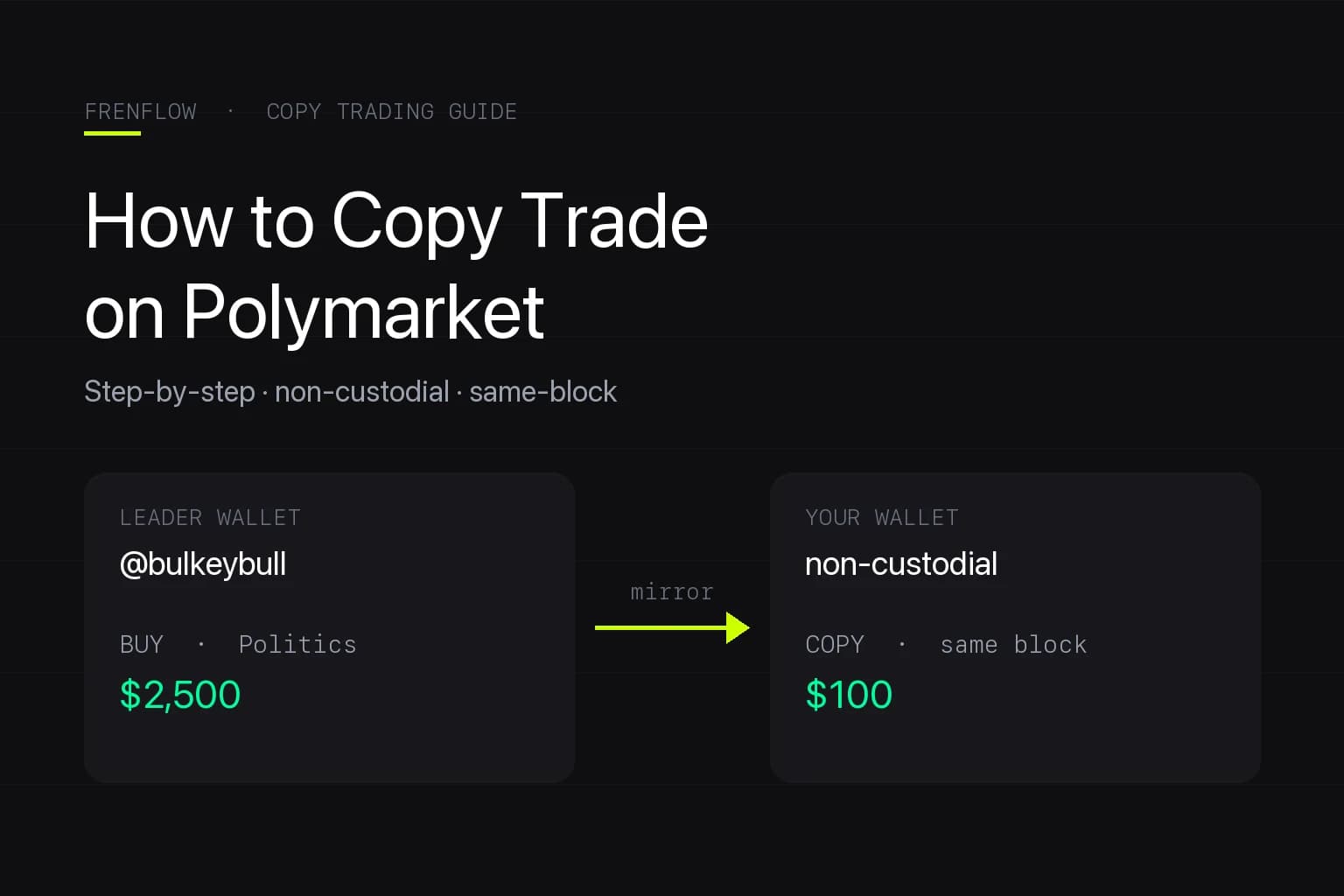
- Choose a wallet with a copyable edge: Start from a leaderboard ranked by realized on-chain PnL, not raw volume. The FrenFlow traders leaderboard ranks every Polymarket wallet by verified performance, so you begin with proven records. Then look past the profit column at the market count — it tells you whether the edge is copyable. A wallet like @BulkeyBull, up roughly +$106K across just 116 geopolitics and politics markets, is an informed directional trader you can actually follow at a similar price. A wallet up six figures across tens of thousands of short, fast-resolving crypto candles is a high-frequency bot whose edge is latency you can't replicate. Copy the first kind, not the second.
- Match the leader to a category: A trader's edge is usually narrow. A crypto specialist's political bets carry no signal. Identify the one category where the wallet actually outperforms and plan to copy only that part of its activity, so you inherit the edge instead of diluting it.
- Connect your own wallet: Sign in to FrenFlow and use your embedded, non-custodial wallet. Your funds never leave your control — the platform executes against your wallet but never takes custody of it. Fund it with the USDC you're willing to allocate.
- Set your copy mode and stake: Decide whether to mirror a fixed dollar amount per trade or a percentage of the leader's position size. Fixed staking keeps your risk constant; percentage staking scales with the leader's conviction. Pick the one that matches how much you trust the wallet.
- Set your risk limits: Configure a maximum stake per trade so a single oversized position from the leader can't blow up your allocation. This is the guardrail that lets you copy a high-conviction trader without inheriting their worst day at full size.
- Decide whether to follow sells: A leader's exits carry as much information as their entries. Choose whether to mirror their sells automatically — most traders should, because a wallet that quietly closed a position you're still holding has told you something.
- Activate and let it run in the same block: Once your rules are set, the system watches the leader's wallet and mirrors qualifying trades automatically. The only thing that matters now is speed: detecting the move from the mempool and executing in the same block is what gets you the leader's entry price instead of the market's reaction to it.
The first six steps are decisions you make once. The seventh is a race the system runs for you every time the leader moves — including at 3 AM, which is the entire reason to automate instead of watching alerts yourself.
Why Execution Speed Decides Your Return
Wallet selection determines whether you're following a good trader. Execution speed determines whether following them is worth anything.
Price impact compounds per block. On Polygon, blocks are produced roughly every two seconds, and on an active market each block of delay means more participants have seen the leader's move and adjusted. Detect the trade in the mempool — the queue of transactions waiting to be mined — and you can enter in the same block, at the leader's conditions. React to a confirmed transaction off a block explorer and you're buying the move you were supposed to front-run, several cents worse.
This is why "copy trading" off a dashboard that refreshes every few minutes isn't really copy trading. It's late mimicry. We break down the mechanics of same-block execution in detail in Block 0 copy trading, and it's the single feature that separates a copy-trading tool that captures the edge from one that inherits the slippage.
Fixed vs Percentage Staking: Which to Choose
The two copy modes suit different levels of trust in a leader.
- Fixed staking puts the same dollar amount behind every copied trade regardless of the leader's size. Your risk per trade is constant and predictable. This is the right default when you're validating a new wallet — for example a sports specialist like @FullPicks1, up roughly +$266K across 224 markets — so you can confirm the edge holds before scaling.
- Percentage staking scales your position with the leader's. When they bet big, you bet big; when they bet small, you bet small. This mirrors the leader's conviction and suits a high-trust follow of a discretionary specialist — but it transfers their position-sizing risk to you, so cap it with a maximum stake per trade.
Whichever you choose, the maximum-stake limit from step 5 is non-negotiable. It's the difference between copying a trader's edge and copying their tail risk.
Manual vs Automated Copying
Once you've picked a wallet, you can act on its trades two ways.
Manual copying means you watch alerts and place each order yourself. You keep full discretion, but you're physically racing the market every time the leader moves, and you can't be awake for all of it. It's fine for a wallet you check casually.
Automated copying means you set your rules once and the system mirrors qualifying trades in real time. You trade the leader's discipline without having to be present for it, and — critically — you execute fast enough to actually capture the entry. For any wallet whose edge depends on speed, automation isn't a convenience; it's the only way the copy is worth making. The deeper trade-offs, security model, and setup live in our pillar guide to the best copy trading bot for Polymarket.
Common Copy Trading Mistakes to Avoid
- Copying volume instead of skill. A nine-figure book isn't automatically a good follow. Check the PnL-to-volume ratio and the category record, not just the turnover.
- Copying PnL instead of a copyable edge. The highest-profit wallets on the leaderboard are often high-frequency crypto-candle bots or market-makers whose edge is latency, not information — by the time you see the trade, the five-minute candle has already resolved. A smaller wallet with a real, slow-moving thesis is a far better follow than a green bot you can't actually mirror.
- Following across categories. Copying a politics specialist's occasional sports bet turns a real signal into a coin flip. Segment the leader's history and copy only their edge.
- Skipping risk limits. Without a maximum stake per trade, one oversized position from the leader can wipe out a month of careful gains. Set the limit before you activate.
- Ignoring exits. If your setup mirrors entries but not sells, you'll hold positions the leader has already abandoned. Follow sells unless you have a specific reason not to.
- Trusting a tool with custody. If a service requires you to deposit funds into its wallet, the convenience isn't worth it. Keep your funds in a wallet you control.
- Reacting to stale data. A trade you saw on a block explorer is one the market already absorbed. If the copy isn't happening in real time, you're trading history.
From Setup to Strategy
Copy trading on Polymarket is genuinely simple to start: pick a verified wallet, connect your own non-custodial wallet, set your stake and limits, and let the system mirror qualifying trades. The ten-minute setup hides the two things that actually drive your return — choosing a wallet with a real, category-specific edge, and executing fast enough to follow it at the leader's price.
FrenFlow handles both. Browse the traders leaderboard to find wallets ranked by verified on-chain PnL, audit any record before you follow it, and copy qualifying trades in the same block the leader does. Funds stay in your own wallet, it works across the web app and Telegram, and there's no subscription — just the standard on-chain trading fee.
Start by copying one wallet with fixed staking and a conservative limit. Watch it for a week. Then scale the stake, add a second wallet in a different category, and turn a single follow into a diversified strategy. If you want help choosing who to start with, our ranking of the best Polymarket traders to follow is the place to begin.
Frequently Asked Questions
Can you copy trade on Polymarket?
Yes. Because every Polymarket position settles on-chain on Polygon, a wallet's trades are public, and tools like FrenFlow let you automatically mirror a chosen wallet's qualifying trades into your own non-custodial wallet. You pick a leader with a verified on-chain record, set your stake and risk limits, and the system copies their trades in real time. Your funds stay in a wallet you control the entire time.
How do I choose which trader to copy on Polymarket?
Start from a leaderboard ranked by verified realized PnL, not raw volume — then check the market count, because it reveals whether the edge is copyable. The strongest follows are informational specialists with an actionable horizon: a politics wallet like @BulkeyBull (+$106K across 116 markets) or a sports wallet like @FullPicks1 (+$266K across 224 markets), where you can read the thesis and still enter near their price. Avoid the highest-PnL bots — wallets churning tens of thousands of short-window crypto candles — because their edge is latency you can't replicate, not information you can act on. A smaller wallet with a consistent, category-specific record beats a green bot every time.
Is copy trading on Polymarket safe?
It's safe when the tool is non-custodial. On FrenFlow your funds stay in your own embedded wallet and the platform executes against it without ever taking custody. The real risk in copy trading is choosing a bad wallet, which is why you audit the verified on-chain record first, and setting a maximum stake per trade so a single oversized position from the leader can't blow up your allocation. Never use a service that requires you to deposit funds into its own wallet.
How much does it cost to copy trade on Polymarket?
On FrenFlow there's no subscription to copy trade — you pay only the standard on-chain trading fee when a trade actually executes. That keeps the cost proportional to your activity rather than a fixed monthly charge, so validating a leader with small stakes stays cheap.
What's the difference between fixed and percentage copy trading?
Fixed staking puts the same dollar amount behind every copied trade, keeping your per-trade risk constant — the right default when validating a new wallet. Percentage staking scales your position with the leader's size, mirroring their conviction but transferring their position-sizing risk to you. Both should be paired with a maximum stake per trade so a single large position can't dominate your allocation.
Do I need to be online to copy trades on Polymarket?
No, and that's the main reason to automate. With automated copy trading you set your rules once and the system mirrors qualifying trades in real time, including overnight, executing in the same block as the leader. Manual copying requires you to watch alerts and place each order yourself, which means you miss moves you're asleep for and you're slower to the entry.

Related articles

Fireplace.gg Alternative: Best Options for Polymarket Traders (2026)
Aug 14, 2026

Polymarket Alternatives: 7 Best Prediction Markets in 2026
Jun 24, 2026

Polymarket Sports Betting: How Sports Trading Works (2026)
Jun 24, 2026
 Start Copying Now