
Gavin Newsom Commands 24% in Polymarket's $822M 2028 Dem Primary
Gavin Newsom's Early Lock on 2028
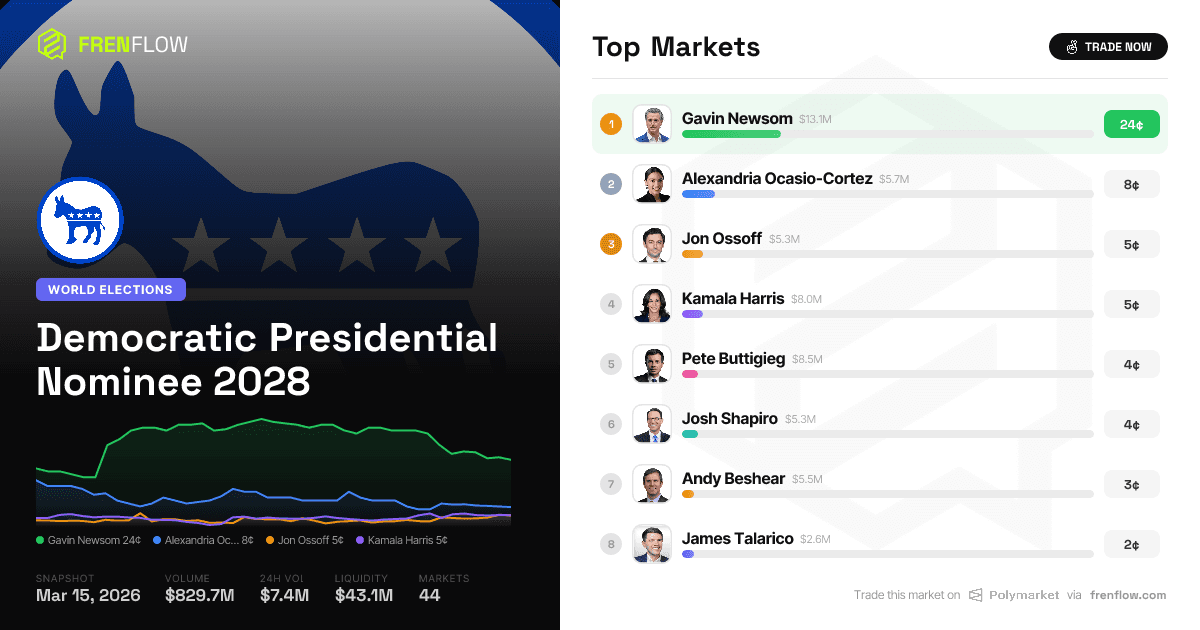
Gavin Newsom sits at 24.2 cents in the $822 million Democratic Presidential Nominee 2028 market — a commanding lead that says more about the field's weakness than California's governor's strength. With no candidate above 9%, traders are essentially betting on chaos.
The numbers tell the story of a party without a clear succession plan. Newsom's $12.71M in volume suggests serious money believes he's the frontrunner, but at under 25% implied probability, the smart money isn't convinced either. Alexandria Ocasio-Cortez trails at 8.6% with just $5.61M in volume, while Jon Ossoff rounds out the top three at 5.0%.
The Volume-Price Disconnect
Here's where this market gets interesting: volume doesn't follow price. Oprah Winfrey sits at 0.7% odds but has attracted $39.28M in trading volume — more than triple Newsom's $12.71M. Similarly, Chelsea Clinton trades at 0.8% but commands $42.11M in volume, the highest single-name total.
This pattern screams entertainment betting rather than serious political analysis. When George Clooney ($34.10M volume, 0.8% price) and Kim Kardashian ($25.38M volume, 0.9% price) are moving serious money, you're looking at meme trading with a political wrapper.
| Top Volume vs Top Price | Volume | Price | Implied Probability |
|---|---|---|---|
| Chelsea Clinton | $42.11M | 0.8¢ | 0.8% |
| Oprah Winfrey | $39.28M | 0.7¢ | 0.7% |
| Bernie Sanders | $35.25M | 0.7¢ | 0.7% |
| Gavin Newsom | $12.71M | 24.2¢ | 24.2% |
| AOC | $5.61M | 8.6¢ | 8.6% |
The Real Contenders
Strip away the celebrity noise and focus on volume-to-price ratios that make sense. Newsom's position reflects genuine political calculation — California's electoral votes, progressive credentials that don't scare moderates, and executive experience. His $12.71M in volume at 24.2 cents suggests conviction, not speculation.
AOC's 8.6% feels light given her national profile and fundraising ability. At $5.61M in volume, she's being undervalued by a market that may be overweighting electability concerns. Josh Shapiro at 3.9% ($5.26M volume) represents better value — Pennsylvania's governor in a party that desperately needs to win back working-class voters.
Pete Buttigieg's 3.5% price tag looks reasonable for someone who's already run a credible presidential campaign and holds a Cabinet position. His $8.21M in volume suggests patient money is accumulating shares.
The Timeline Problem
This market expires November 7, 2028 — roughly two and a half years out. That's still a long window in politics, but the betting timeline is narrower than it appears. Primary campaigns launch two years before general elections, meaning serious positioning starts in 2026. Any candidate not building infrastructure by mid-2026 won't have the organization to compete.
Newsom benefits from this timeline. He'll finish his second gubernatorial term in January 2027, perfectly positioned for a presidential run. Shapiro faces re-election in 2026 — a potential complication if Pennsylvania swings further red. AOC turned 35 in October 2024 and is constitutionally eligible, but faces a compressed timeline to build national campaign infrastructure.
Celebrity Arbitrage
The entertainment betting creates obvious arbitrage opportunities. Barack Obama at 0.9% is free money for anyone willing to tie up capital until late 2028 — he's constitutionally ineligible for a third term. Similar logic applies to Hillary Clinton (0.9%), though the market may be pricing in constitutional amendments or VP succession scenarios that won't materialize.
LeBron James ($30.42M volume, 1.1% price) and MrBeast ($31.81M volume, 0.9% price) represent peak stupidity. These positions will decay to zero as 2026 approaches and serious candidates emerge. The only question is timing — will the celebrity premium collapse gradually or all at once?
What's Missing
The market underprices governors not named Newsom. Andy Beshear at 2.5% looks cheap for someone who won Kentucky twice as a Democrat. Gretchen Whitmer at 1.5% seems absurdly low given Michigan's swing-state importance and her 2022 re-election margin.
Senators are overpriced relative to governors. Jon Ossoff's 5.0% reflects name recognition from his high-profile 2020-2021 campaigns, but governors have better presidential track records. Raphael Warnock at 0.8% might be the exception — he's proven he can win Trump voters in Georgia.
The Catalysts
Three events will reshape this market: the 2026 midterms, early primary state visits, and fundraising reports. Governors who survive 2026 in purple states become instant contenders. Anyone making multiple Iowa or New Hampshire trips before Labor Day 2026 gets a price bump. Q1 2027 fundraising numbers will separate serious candidates from also-rans.
Democratic primary voters have shown they'll rally behind whoever looks most electable against the Republican nominee. That calculus won't clarify until late 2027 at earliest, keeping this market fragmented longer than historical precedent suggests.
Risk Scenarios
Newsom's lead could evaporate quickly. California Democrats haven't won presidential elections since 1964. His progressive positions on homelessness, immigration, and business regulation may play differently in Iowa than San Francisco.
The bigger risk is a total outsider capturing lightning in a bottle. Obama wasn't in similar markets in 2004. Bill Clinton would have been a longshot in 1988. If this Democratic primary becomes about generational change rather than experience, everyone over 55 becomes vulnerable.
Chelsea Clinton's massive volume suggests some traders are betting on dynasty politics. While unlikely, a Clinton entry would scramble the entire field and potentially crater Newsom's frontrunner status.
Trading Strategy
Newsom at 24.2% offers limited upside but decent floor protection. He's the closest thing to a consensus frontrunner, making his shares useful for portfolio hedging.
The value plays are Shapiro (3.9%), Whitmer (1.5%), and potentially Warnock (0.8%). All three combine electoral college math with proven ability to win tough races.
Short every celebrity above 0.5% who isn't a politician. Obama, Oprah, LeBron, and MrBeast positions will eventually transfer to real candidates. The question isn't if, but when.
Frequently Asked Questions
Q: Why is Gavin Newsom the betting favorite for 2028? A: Newsom leads at 24.2% due to his California governorship, progressive credentials that don't alienate moderates, and executive experience. His timeline also works — he finishes his gubernatorial term in January 2027, perfectly positioned for a presidential run.
Q: Which candidates are undervalued in this market? A: Josh Shapiro (3.9%) and Gretchen Whitmer (1.5%) look underpriced given their swing-state appeal. Both have proven they can win tough races in states Democrats need for the Electoral College.
Q: Why are celebrities like Oprah and LeBron James getting significant volume? A: Entertainment betting drives volume on celebrity names despite minimal political viability. Oprah has $39.28M in volume at just 0.7% odds, suggesting meme trading rather than serious political analysis.
Q: When will this market start reflecting realistic candidates? A: Expect major shifts after the 2026 midterms and when serious candidates begin making early primary state visits in late 2026. Q1 2027 fundraising reports will separate real contenders from the field.

 Start Copying Now