

ColdMath on Polymarket: The Weather Trader With a 50-0 Record
The Penny Weather Machine
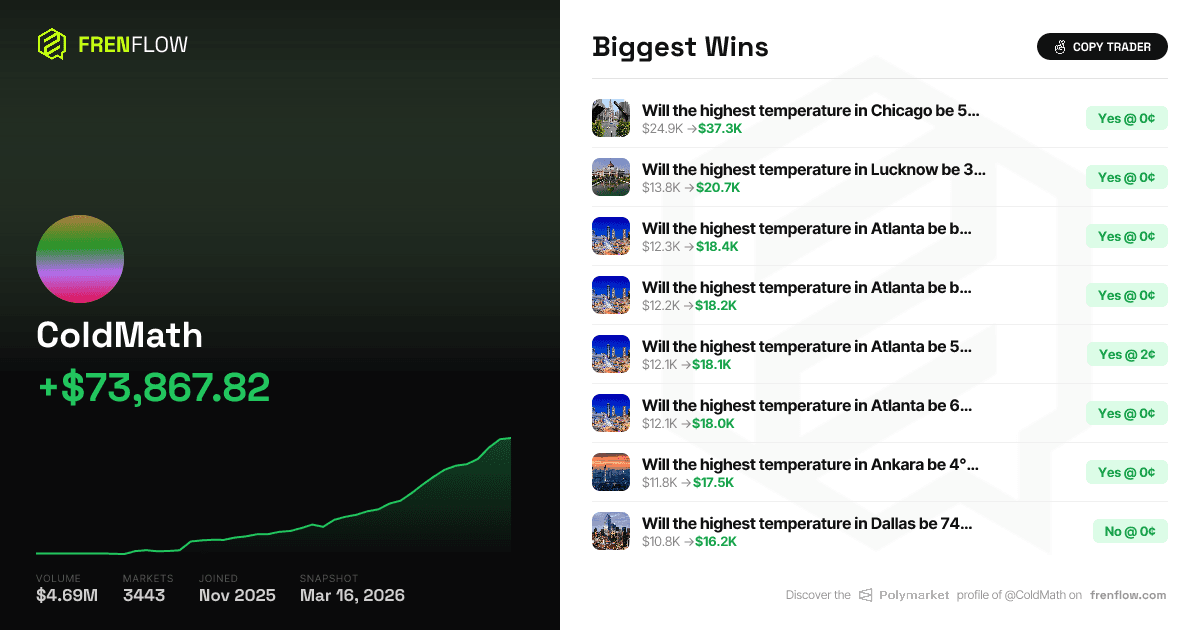
Fifty closed trades. Fifty wins. Zero losses. $174K in profit from buying shares at prices between 0.1¢ and 4.3¢ — fractions so small they barely register as prices at all. ColdMath has built one of the most unusual track records on Polymarket: a perfect record across 3,461 markets traded, generated almost entirely from hyper-specific weather prediction markets in cities spanning Chicago, Atlanta, Dallas, Lucknow, Ankara, London, Paris, Munich, Wellington, and Seoul.
The bio reads "Edge Compounds." The data says something more specific: this is a trader who identified that Polymarket's weather markets systematically misprice certain outcomes at sub-penny levels, and who has been harvesting that inefficiency with methodical consistency since joining in November 2025 — roughly four months ago.
But a 50-0 record with $4.69M in total volume and only $74K in net profit (1.58% margin) tells a more complex story than the perfect win rate suggests. ColdMath isn't a prophet. ColdMath is an arbitrageur operating in a specific market microstructure niche — and the gap between $174K in closed wins and $74K in net profit reveals exactly where the hidden costs live.
How the Strategy Works
The pattern across ColdMath's top 25 winning trades is strikingly uniform. Every single one targets a weather outcome — a specific high temperature in a specific city on a specific date. The entry prices cluster overwhelmingly at 0.1¢ to 0.3¢, with occasional entries at 1.0¢–4.3¢. Position sizes range from $6K to $25K in shares purchased.
Here's the mechanical logic: Polymarket's weather markets offer granular outcomes — "Will the high in Atlanta be between 66-67°F on March 14?" These markets resolve daily. For any given city, there might be a dozen or more temperature brackets available. Most will resolve No. A few will resolve Yes. At any moment before resolution, the vast majority of these hyper-specific brackets trade at near-zero prices because the probability of any single 1-2 degree bracket being correct is genuinely low.
ColdMath's edge appears to be weather forecasting. Not casual "check-the-app" forecasting — precision forecasting that narrows the likely high temperature to a small range, then buying the corresponding bracket at sub-penny prices when the market hasn't yet incorporated the latest forecast data.
| Metric | Value | What It Reveals |
|---|---|---|
| Average winning entry price | ~0.5¢ | Buying deep out-of-the-money weather outcomes |
| Typical ROI per winning trade | 2,700% – 49,900% | Massive payoffs when a 0.1¢ position resolves to $1 |
| Closed record | 50-0 | Perfect — but only on positions that have closed |
| Total closed profit | $174K | The gross engine |
| Net profit (all activity) | $74K | $100K gap demands explanation |
| Markets traded | 3,461 | Vast majority are positions we can't see in the top winners |
The ROI numbers look hallucinatory. A 49,900% return on the London 10°C trade. A 49,733% return on the Chicago 54°F trade. But these percentages are artifacts of buying at 0.1¢ — when you pay a tenth of a penny per share, any resolution to $1 yields a ~100,000% gross return. The dollar profits are more grounded: $3K–$12K per winning trade, depending on position size.
The $100K Question
Here's where the analysis gets interesting. ColdMath shows $174K in profit from 50 closed winning positions and $0 in closed losses. Yet total net profit is only $74K. That $100K gap — roughly 57% of gross winnings — has to come from somewhere.
The data gives us clues. ColdMath has traded 3,461 markets. We can see the top 50 wins. That leaves 3,411 markets unaccounted for in the detailed breakdown. The "trade count" field shows 0, which likely reflects a data aggregation quirk rather than literal zero trades, given the $4.69M in volume.
The most plausible explanation: ColdMath is buying sub-penny shares across hundreds of weather brackets simultaneously, knowing that most will expire worthless. If the high in Atlanta lands at 67°F, the 66-67°F bracket pays — but the 64-65°F, 65-66°F, 68-69°F, and every other bracket ColdMath also bought expires at zero. The 50 wins we see are the survivors. The $100K in missing profit represents the cost basis of thousands of losing micro-positions that each lost $10, $50, or $200 when they resolved No.
This reframes the strategy entirely. ColdMath isn't making 50 surgical bets and winning all 50. ColdMath is more likely making hundreds of correlated bets per weather event — covering a range of plausible temperature outcomes — and reliably winning a subset while absorbing small losses on the rest. The "50-0" closed record probably reflects a reporting threshold that only surfaces the winning side of a spread strategy.
The effective margin tells the real story: 1.58% on $4.69M in volume. That's $74K on nearly $5M deployed. Respectable, consistent, but not miraculous. It's the margin of a sophisticated market maker, not a clairvoyant.
The Forecasting Edge — Real, but Perishable
Web research confirms the kind of weather data ColdMath is trading against. March 2026 has seen unusual temperature patterns globally: India recorded temperatures crossing 40°C in 14 cities, breaking a 15-year record for the month. Chicago saw highs swinging from the 40s to near 60°F within days. These volatile conditions create exactly the kind of forecast-vs-market dislocation that ColdMath exploits.
Consider the Lucknow 39°C trade from March 7. Historical averages for Lucknow in early March run well below 39°C — that figure is closer to the city's typical April high, when daily highs average around 39°C — but 2026's heat wave pushed temperatures 5-8°C above normal across northern India. A trader monitoring real-time meteorological models (GFS, ECMWF, or India's own IMD forecasts) would have seen the 39°C reading coming 24-48 hours before the market priced it in. At 0.1¢, the market was saying the probability was roughly 0.1%. The weather models were saying something closer to 10-30%. That's the gap.
ColdMath's open positions on March 16 reveal the strategy in real time. The portfolio holds simultaneous positions across Chicago, Dallas, Ankara, Buenos Aires, Munich, Seoul, Lucknow, and Miami — all for dates within 24-48 hours. Most are No positions bought at 94¢–98¢, which is the mirror image of the sub-penny Yes strategy: betting against specific brackets that the forecast has ruled out, capturing the last few pennies as the market converges to 100¢.
| Open Position Type | Entry Range | Typical Gain | Risk Profile |
|---|---|---|---|
| "No" on unlikely brackets | 94¢–98¢ | $14–$322 per position | Low per-trade, but capital-intensive |
| "Yes" on likely brackets | 88¢–99¢ | $28–$117 per position | Modest upside, near-certain resolution |
| Sports bet (Inter Milan -1.5) | 18.4¢ | -$129 (unrealized) | Different strategy entirely — and losing |
The Inter Milan spread bet jumps off the page. It's the only non-weather position in the entire portfolio, it's the only current position in the red, and at -$129 it's a small but telling data point. ColdMath's edge is weather-specific. The one departure from that edge is underwater. The bio says "Edge Compounds" — but edge also has boundaries.
The Risk No One Is Pricing
A 50-0 record creates a dangerous narrative. The actual risk profile of this strategy has three layers worth examining.
Layer 1: Model risk. ColdMath's profits depend on weather forecasts being more accurate than the market's implied probability. Modern 24-48 hour forecasts are highly accurate for temperature highs — typically within 2-3°F. But "highly accurate" isn't "perfectly accurate." A sudden cold front, an unexpected cloud layer, or a heat dome that stalls could push the actual high outside ColdMath's covered range. When that happens, every bracket purchased for that city-date combination loses simultaneously. The correlation risk is 100% — all positions on a single weather event fail together.
Layer 2: Liquidity risk. ColdMath is deploying $6K–$25K per position in markets that likely have thin order books. The sub-penny entry prices suggest these markets have very few participants. That's great for finding edge — but it also means ColdMath can't easily scale without moving prices, and can't exit positions early if the forecast changes. These are hold-to-resolution bets.
Layer 3: Platform risk. With 3,461 markets traded in roughly four months, ColdMath is placing approximately 29 market entries per day. This volume in weather markets — which resolve daily and mechanically — raises questions about sustainability. If Polymarket changes its weather market structure, adjusts resolution sources, or if other traders begin replicating this strategy and compressing the sub-penny edge, ColdMath's margin (already at 1.58%) could evaporate quickly.
The $67K current balance, against a total profit history of $74K, suggests ColdMath is operating with most of their capital deployed at any given time. This is a high-utilization strategy — capital recycled daily as weather markets resolve, immediately redeployed into the next day's brackets. There's no large cash buffer visible.
Edge Compounds — Until It Doesn't
ColdMath has built something genuinely clever: a systematic, repeatable process for extracting value from a market microstructure inefficiency. The strategy monetizes a real informational edge (superior weather forecasting, or at minimum, faster incorporation of publicly available forecast data) in markets too small and niche for most traders to bother with.
The 1.58% net margin on $4.69M in volume works out to about $18.5K per month over four months. That's a respectable income stream from what appears to be a semi-automated process — the geographic diversity (ten-plus cities across four continents) and daily cadence suggest some level of systematic infrastructure.
But the fragility is real. The strategy works because weather markets on Polymarket are inefficient. Inefficiencies get arbitraged away. ColdMath's own activity — $4.69M in volume flowing through these markets — is itself a force that should, over time, push prices closer to fair value and compress the very edge being exploited. Edge compounds, as the bio says. But so does competition.
The trader's data is tracked on FrenFlow's ColdMath profile, where the real-time position updates reveal the daily rhythm of this strategy better than any snapshot can.
For now, the weather keeps changing, the forecasts keep being right, and the pennies keep adding up. The question isn't whether ColdMath has edge. The data makes that clear. The question is how many other traders are reading this and thinking they can do the same thing — and what happens to a 1.58% margin when they try.
Frequently Asked Questions
How much profit has ColdMath made on Polymarket?
ColdMath has generated $174K in gross profit from 50 closed winning trades, with a net profit of approximately $74K after accounting for losing positions across 3,461 markets. Total trading volume stands at $4.69M since November 2025, yielding a net margin of 1.58%.
What is ColdMath's trading strategy on Polymarket?
ColdMath specializes almost exclusively in weather prediction markets, buying shares in specific temperature-bracket outcomes at sub-penny prices (typically 0.1¢–0.3¢) across cities worldwide. The strategy relies on weather forecast data to identify which temperature brackets are likely to resolve Yes, buying them before the market adjusts from near-zero pricing. The trader covers multiple brackets per event, winning on a subset while absorbing small losses on the rest.
Does ColdMath have a 100% win rate on Polymarket?
The visible record shows 50 wins and 0 losses among closed positions that meet reporting thresholds. However, total net profit ($74K) is significantly less than gross winning profit ($174K), indicating approximately $100K in losses from positions too small to appear in the top trade data. The effective strategy is profitable but far from lossless.
What cities does ColdMath trade weather markets for?
ColdMath's positions span a global range including Chicago, Atlanta, Dallas, and Miami in the United States; London, Paris, Munich, and Ankara in Europe and the Middle East; Lucknow in India; Seoul in South Korea; Wellington in New Zealand; and Buenos Aires in Argentina. This geographic diversification allows daily trading across multiple time zones and climate conditions.
Is ColdMath's Polymarket weather strategy sustainable long-term?
The strategy exploits a specific inefficiency: weather markets pricing temperature brackets at near-zero when meteorological forecasts suggest meaningful probability. Key risks include forecast model errors (where all correlated positions lose simultaneously), increased competition compressing sub-penny edges, and potential changes to Polymarket's weather market structure. The 1.58% net margin leaves limited room for any deterioration in edge quality.

 Start Copying Now