


Bitcoin March 2026 Price Market: Polymarket's $42M Bet Decoded
The $12 Million Lottery Ticket
Nearly one in every three dollars traded in Polymarket's $41.9M Bitcoin March price market has flowed into the single least likely outcome: Bitcoin hitting $150,000 before April 1. That strike trades at 0.4¢ — a 250-to-1 payout — yet it has attracted $12.07M in volume, more than triple the next-highest outcome. Strip out that lottery ticket flow, and the "real" market — the one actually pricing Bitcoin's near-term range — runs on roughly $30M. That distinction matters enormously for anyone trying to extract signal from this market with 17 days left until expiration.
The thesis is straightforward: this market's headline volume overstates its informational depth. The genuine price discovery is happening in a narrow band between $65,000 and $85,000, where implied probabilities and volume align. Everything outside that band is noise, entertainment money, or tail-risk speculation. Understanding which is which separates a useful probability distribution from a misleading one.
Where the Market Actually Thinks Bitcoin Is
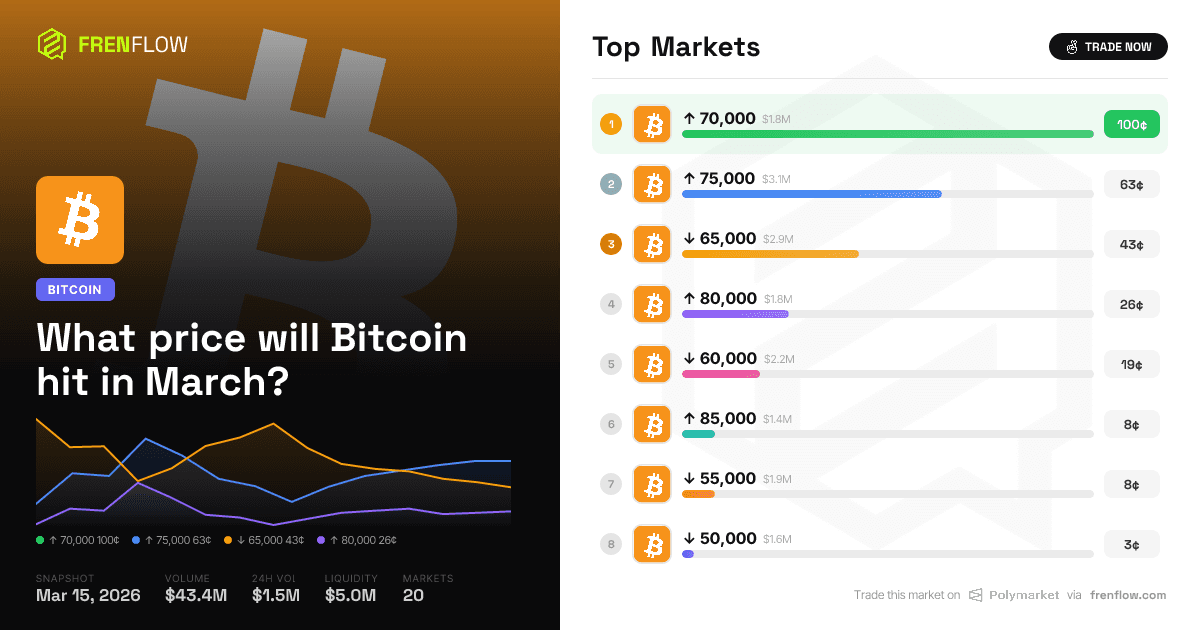
The two outcomes that bracket current market consensus are ↑ $75,000 (57.5¢) and ↓ $65,000 (51.1¢). Bitcoin touching $75,000 at some point this month carries a 57.5% implied probability. Bitcoin dipping to $65,000 carries a 51.1% implied probability. Since these are "touch" markets — they resolve Yes if Bitcoin hits the level at any point during March — both can resolve Yes simultaneously. The market is effectively saying: expect a volatile month with a range wide enough to tag both levels.
Let's reconstruct the implied distribution from the data:
| Price Zone | Direction | Implied Prob. | Volume | Signal |
|---|---|---|---|---|
| $75,000+ | ↑ | 57.5% | $3.03M | Market's median upside expectation |
| $80,000+ | ↑ | 24.0% | $1.77M | Roughly 1-in-4 chance of a meaningful rally |
| $85,000+ | ↑ | 7.5% | $1.39M | Tail upside — priced but not expected |
| ≤ $65,000 | ↓ | 51.1% | $2.84M | Coin-flip on a downside wick |
| ≤ $60,000 | ↓ | 22.5% | $2.10M | Comparable to the $80K upside strike |
| ≤ $55,000 | ↓ | 9.5% | $1.83M | Tail downside — slightly more volume than $85K upside |
The symmetry is revealing. The market assigns roughly equal probability to Bitcoin reaching $80,000 (24.0%) and falling to $60,000 (22.5%). It assigns comparable probability to $85,000 (7.5%) and $55,000 (9.5%). But here's the asymmetry that matters: the downside tail is marginally fatter. Bitcoin dropping below $50,000 (4.1%) carries more implied probability than it rising above $90,000 (2.4%). This slight bearish skew persists across the entire distribution.
With ↑ $70,000 priced at 100.0¢ — certainty — the market is telling us Bitcoin is currently trading somewhere above $70,000 or so close to it that a touch is considered guaranteed. The real action is in the gap between $70K (certain) and $80K (24% likely). That $10,000 band is where the market's conviction drops from 100% to less than one-in-four.
The Volume Anomaly: Lottery Tickets vs. Information
The $150,000 strike deserves its own section because its volume distortion is extreme and instructive.
At $12.07M in volume and a 0.4¢ price, here's the math: if you bought $100 of Yes shares at 0.4¢, you'd own 25,000 shares. If Bitcoin somehow touched $150,000 in the next 17 days — a roughly 75-80% move from current levels — those shares pay $25,000. A 250x return. The expected value, at the market's own implied probability of 0.4%, is $100 × 250 × 0.004 = $1.00. You're paying $100 for $1 of expected value. This is pure lottery ticket behavior.
But the volume tells us something else. $12.07M hasn't just flowed in one direction. Much of this volume likely reflects repeated churn — traders buying at 0.3¢ and selling at 0.5¢, market makers providing liquidity, and speculators cycling in and out. The actual open interest is almost certainly a fraction of the volume figure. Still, the fact that the ↑ $150K outcome has generated more turnover than any other single strike — more than ↑ $75K ($3.03M), more than ↓ $65K ($2.84M), more than all the informative mid-range strikes combined — tells us the market's participant base skews heavily toward entertainment and moonshot speculation.
The same pattern appears at the bottom: ↓ $20,000 at 0.4¢ has attracted $1.79M in volume. A crash to $20K would require a roughly 70%+ decline in 17 days. This isn't analysis — it's apocalypse tourism.
For serious traders, the takeaway is to weight your reading of this market toward the $65K–$85K zone, where volume and probability are directionally aligned and the participants are more likely to be expressing informed views rather than buying scratch-off tickets.
The $4.27M Daily Surge and What's Driving It
Today's $4.27M in 24-hour volume represents roughly 10% of the market's entire lifetime turnover concentrated in a single day. That kind of spike, halfway through the month, typically signals one of three things: a sharp move in Bitcoin's spot price forcing position adjustments, a catalyst that has shifted the probability distribution, or a large player entering or exiting.
The $4.78M in current liquidity provides context. With nearly as much volume as liquidity in a single 24-hour period, the order books have been heavily utilized. For the mid-range strikes — where spreads matter most — this suggests either significant new positioning or a repricing event. If Bitcoin moved sharply in the last 24 hours, we'd expect the probability surface to shift accordingly, with traders covering losing positions on one side and new money flowing into strikes that are now more realistic.
Tracking this on FrenFlow's market page gives a clearer picture of how the probability curve has shifted over time.
The ↑ $80K strike at 24.0¢ is the most analytically interesting position in the market right now. A $1,000 Yes position at that price pays $4,167 if Bitcoin touches $80,000 at any point before April 1 — a 4.17x return. Annualized over the remaining 17 days, that's an absurd return if you assign a probability materially above 24%. The question is whether the market is correctly pricing this or whether the bearish skew we identified earlier means participants are underweighting a potential rally. For anyone with a directional spot view, this strike offers leveraged expression of that thesis.
Conversely, the ↓ $60K at 22.5¢ offers similar mechanics on the downside. The near-symmetry between these two strikes suggests the market sees roughly equal risk of a $10K+ move in either direction from around current levels.
What Could Move This Market 10+ Cents
With 17 days remaining (March 14 to April 1), here's the catalyst map for the strikes that matter:
| Catalyst Type | Impact Zone | Probability Shift |
|---|---|---|
| FOMC meeting / rate decision (March 18-19) | All strikes shift | Could reprice ↑ $80K and ↓ $60K by 5-10¢ each |
| Major macro shock (banking stress, geopolitical event) | Downside strikes surge | ↓ $55K could jump from 9.5¢ to 20¢+ |
| Spot Bitcoin ETF flow reversal or acceleration | Upside or downside | Large daily flows move BTC $2-5K intraday |
| Bitcoin-specific regulatory news | Directional | Could push ↑ $85K above 15¢ or collapse it |
| Technical breakout/breakdown from current range | Adjacent strikes | The ↑ $80K and ↓ $65K strikes are most sensitive |
The FOMC meeting is the single most important dated catalyst. If the Fed signals more cuts or a dovish shift, risk assets rally and the upside strikes reprice higher. If the Fed surprises hawkish, downside strikes gain. The market's current near-symmetry between upside and downside suggests participants haven't positioned heavily for a specific FOMC outcome — or that the two camps are roughly balanced.
What the Market Gets Right and Where It Might Be Wrong
The market gets several things right. The "touch" structure of these outcomes — resolving Yes if a price level is hit at any point during the month — inherently favors wider ranges than point-in-time estimates. A volatile asset like Bitcoin, which routinely moves 5-10% in a week, should have relatively high touch probabilities for levels $5-10K away from the current price. The market's 57.5% for $75K and 51.1% for $65K reflect this correctly.
Where the market might be mispricing risk is in the tail probabilities. The ↑ $90K at 2.4¢ and ↓ $50K at 4.1¢ represent extreme scenarios, but Bitcoin has historically demonstrated the ability to move 20%+ in a matter of days during periods of stress or euphoria. If you believe Bitcoin's current price is roughly in the low-to-mid $70K range (consistent with ↑ $70K being priced at 100¢), then $90K represents approximately a 25% move. In March 2020, Bitcoin fell 50% in two days. In late 2024, it rallied over 40% in a single month. A 2.4% implied probability for a 25% upside move in 17 days may be low for an asset with Bitcoin's volatility profile — though the shorter time window does justify significant discounting.
The other underappreciated feature: all the downside strikes from $50K through $35K carry higher implied probabilities than their equidistant upside counterparts. ↓ $50K (4.1%) vs. ↑ $95K (0.9%); ↓ $45K (1.9%) vs. ↑ $100K (0.8%); ↓ $40K (1.3%) vs. ↑ $105K (0.4%). The market is pricing crash risk as 2-5x more likely than melt-up risk at comparable distances from the current price. Whether this reflects genuine informed positioning or merely a recency bias from recent price action is the key question.
Frequently Asked Questions
What is the Polymarket prediction for Bitcoin price in March 2026?
As of March 14, 2026, Polymarket's touch-price market implies Bitcoin has a 57.5% chance of reaching $75,000 and a 24.0% chance of touching $80,000 at some point during March. On the downside, there's a 51.1% chance of Bitcoin dipping to $65,000 and a 22.5% chance of falling to $60,000. The ↑ $70,000 outcome is priced at 100%, indicating Bitcoin is currently at or above that level.
How much money has been bet on Bitcoin's March 2026 price on Polymarket?
Total volume on this market is $41.93M, with $4.27M traded in the last 24 hours alone. However, $12.07M (29% of total volume) has flowed through the ↑ $150,000 strike alone — a 0.4% probability outcome that functions more as a lottery ticket than serious price discovery. The informational core of the market, concentrated between $65K and $85K, accounts for roughly $12-13M in volume.
What are the odds Bitcoin hits $100,000 in March 2026?
The Polymarket touch-price market prices Bitcoin reaching $100,000 at any point in March 2026 at 0.8% implied probability, with $1.75M in volume on that outcome. This represents a roughly 125x payout if correct. The market clearly views a return to $100K as extremely unlikely within the remaining 17 days of March.
Could Bitcoin crash below $50,000 in March 2026?
The market assigns a 4.1% probability to Bitcoin touching $50,000 in March 2026, with $1.51M in volume. A crash below $40,000 is priced at 1.3%. These are low-probability outcomes, but notably, the market prices downside tail risk 2-5x higher than equidistant upside tail risk, suggesting participants view a sharp sell-off as more plausible than an equivalent rally.
When does the Bitcoin March 2026 price market on Polymarket expire?
The market resolves on April 1, 2026. Each outcome resolves independently — "↑" outcomes resolve Yes if Bitcoin's price touches the specified level at any point during March, while "↓" outcomes resolve Yes if the price falls to or below the specified level. Multiple outcomes can resolve Yes simultaneously.

 Start Copying Now