
bin8888's $146K Crude Oil Bet on Polymarket Is a Clock Game
The Simplest Trade on Polymarket Is Printing $146K
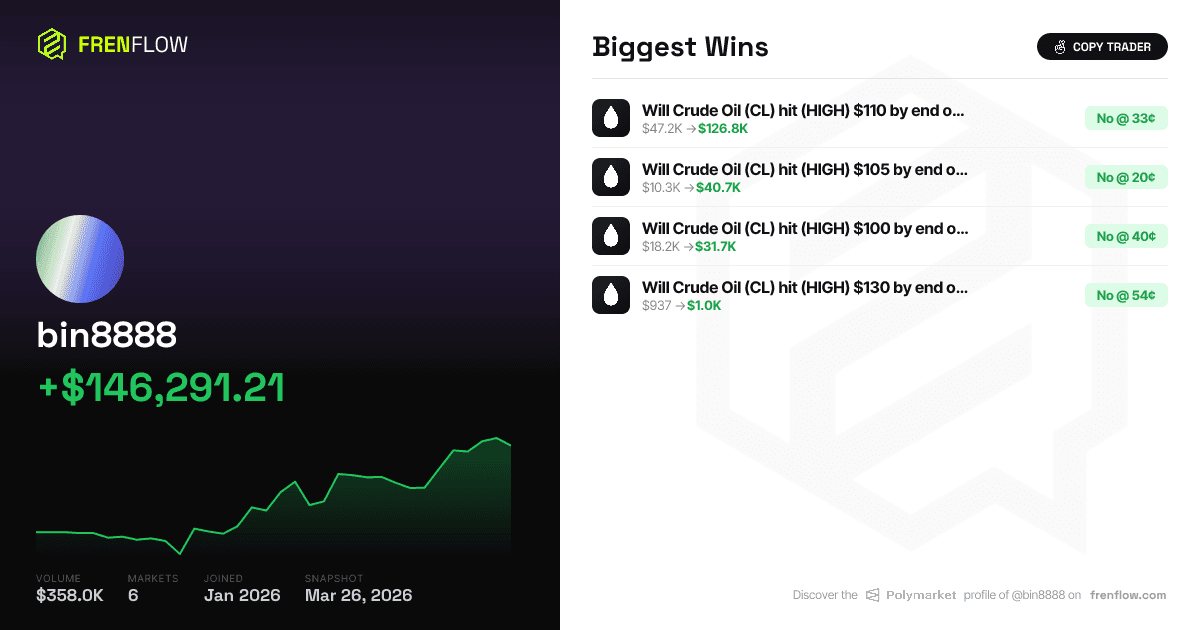
$146,000 in profit from six markets, on a total volume of just $358K — a 40.87% return — and virtually all of it from a single thesis: crude oil is not about to do something crazy. bin8888 joined Polymarket in January 2026, placed a handful of concentrated bets that WTI crude wouldn't breach $100, $105, or $110 before March ends, and is now sitting on roughly $125K in unrealized gains with fewer than six days left on the clock. The 10,209% ROI headline attached to this week's performance isn't the product of genius or leverage engineering. It's the product of time decay on a position that was always likely to win — and a willingness to size into that conviction when the market mispriced the probability.
But the math isn't as clean as it looks. And the final days of an expiring binary contract are exactly when tail risk stops being theoretical.
Anatomy of a Negative Bet
bin8888's core strategy is structurally simple: buy "No" shares on crude oil contracts with strike prices far above the current spot price, and wait. As of late March 2026, WTI crude trades well below $100. The three open positions tell the story:
| Market | Strike | Entry (No) | Current (No) | Shares | Unrealized P&L | Days to Expiry |
|---|---|---|---|---|---|---|
| CL hits $110 by end of March | $110 | 33.0¢ | 88.5¢ | ~$143K | +$80K | ~5 |
| CL hits $105 by end of March | $105 | 20.3¢ | 80.8¢ | ~$51K | +$31K | ~5 |
| CL hits $100 by end of March | $100 | 39.7¢ | 69.5¢ | ~$46K | +$14K | ~5 |
The logic is internally consistent: if crude isn't hitting $130 (bin8888's already-closed winning trade at the same strike structure), it's certainly not hitting $110 or $105. The entry prices reveal that the market, at the time of purchase, assigned a 67% chance that crude would hit $110, a roughly 80% chance it would hit $105, and a 60% chance it would hit $100. Those implied probabilities were, in retrospect, wildly inflated — or reflected deep uncertainty about geopolitical escalation, OPEC+ policy, or supply disruption scenarios that haven't materialized.
bin8888 bought the other side of that fear.
The Conviction Sizing Problem
What makes this portfolio unusual isn't the thesis. Plenty of traders bet against extreme commodity moves. What stands out is the concentration. bin8888's $200K current balance is almost entirely composed of these three crude oil positions. The $143K in shares on the $110 strike alone represents more than 70% of the trader's total volume.
This is not diversification. This is a single macro view expressed through three correlated instruments with the same expiry date. If crude oil somehow gapped above $100 in the next five days — a geopolitical shock, a refinery catastrophe, a Black Swan supply event — all three positions collapse simultaneously. The $125K in unrealized gains evaporates, and the roughly $240K in notional "No" exposure becomes near-worthless.
The Kelly criterion offers perspective. If we estimate bin8888's true edge at roughly 85% (crude staying below $100 with five days left), and the average payout on these contracts at roughly 2.5:1 from entry, Kelly suggests an optimal bet size of roughly 60% of bankroll. bin8888 appears to have allocated closer to 100%. That's aggressive even when you're almost certainly right — because "almost certainly" still has a left tail.
The closed track record reinforces this. bin8888 has exactly one closed win ($86.68 profit on the $130 strike) and one closed loss ($41 on a gold contract). That's a sample size of two. The win rate, profit factor, and edge calculations that would normally anchor analysis are statistically meaningless. Everything rides on the open positions.
Why the Market Was Mispricing
The more interesting question isn't whether bin8888 will win — the odds overwhelmingly favor it — but why these contracts were priced so generously when bin8888 entered.
Consider the $105 strike. bin8888 bought "No" at 20.3¢, implying the market assigned a ~80% probability that crude would hit $105 by end of March. For WTI to move from mid-$60s or low-$70s to $105 in weeks would require a 40-50%+ spike — an event with almost no historical precedent outside the 1990 Kuwait invasion or the 2022 Russia-Ukraine initial shock. Even those moves took longer than a few weeks to fully develop.
So why was the market pricing it so aggressively? Three possible explanations:
1. Thin liquidity inflates implied volatility. Commodity prediction markets on Polymarket are far less liquid than political or crypto markets. A few thousand dollars in panicked "Yes" buying can push implied probabilities to levels that would be arbitraged instantly on CME options desks. bin8888 may have simply been the first person willing to take the other side of illiquid fear.
2. Geopolitical premium without fundamental basis. In early 2026, markets may have been pricing heightened Middle East tensions, potential Strait of Hormuz disruptions, or OPEC+ supply cut escalations. These are real risks — but the probability of their translating into a 40%+ crude price move within weeks rather than months is extremely low.
3. Retail misunderstanding of binary pricing. Many Polymarket participants come from sports betting, where "Will X happen?" markets are intuitive. Commodity strike markets are structurally closer to deep out-of-the-money options — instruments most retail participants systematically misprice by overweighting dramatic scenarios.
bin8888 exploited some combination of all three. That's not genius; it's the kind of edge that exists whenever retail-heavy markets price tail events without proper calibration.
What Could Go Wrong in Five Days
Five days is a short time — but not zero time. The residual risk in bin8888's portfolio isn't trivial, even if the expected value is overwhelmingly positive.
The $100 strike is the most vulnerable. Its current "No" price of 69.5¢ means the market still assigns a ~30% chance crude hits $100 by month's end. That's not a rounding error — it reflects genuine remaining uncertainty, likely driven by the same geopolitical factors that inflated the original pricing. If crude is trading in the mid-$70s, a move to $100 requires roughly a 30% spike in under a week. Improbable but not impossible: the 2020 negative-price event proved that crude can move in ways models don't anticipate.
The $105 and $110 strikes are safer by construction, but they're correlated. Any event that pushes crude toward $100 simultaneously drags down all three positions. bin8888's P&L path from here isn't smooth — it's binary. Either all three positions expire worthless (to "Yes" holders) and bin8888 collects the full notional, or a shock event erases most of the gains.
This is the fundamental asymmetry of selling tail risk: the wins are frequent, small relative to exposure, and predictable. The losses are rare, catastrophic, and surprising. bin8888's current 40.87% return looks spectacular — but it's the return profile of someone who has been picking up nickels in front of a steamroller that hasn't arrived yet.
The Verdict: Edge, but Fragile
bin8888's thesis is sound. Crude oil is overwhelmingly unlikely to hit $105 or $110 by March 31, 2026. The entry prices were generous, the position sizing was aggressive, and the unrealized gains reflect a correct read on both the commodity and the market's mispricing of tail risk.
But calling this a "10,209% ROI" obscures the risk architecture. The return is unrealized. The positions are maximally correlated. The sample size is two closed trades. And the strategy — selling tail risk on illiquid binary contracts — is the exact profile that produces stellar track records right up until it produces catastrophic ones.
If bin8888 closes these positions at or near current values, the $146K profit represents one of the cleaner edge extractions on Polymarket this quarter: identify a mispriced commodity contract, size into it, and let time decay do the work. If a geopolitical event upends crude markets in the next five days, the same positions represent a case study in concentration risk. Position data tracked on FrenFlow will show which outcome materializes.
The trader's real test isn't this week. It's whether they repeat this strategy — buying "No" on overpriced commodity strikes — across enough cycles to build a statistically meaningful track record. Two closed trades tells us almost nothing. Twenty would tell us a lot. Two hundred would tell us whether bin8888 has a genuine informational or analytical edge, or simply had the bankroll to bet against fear at the right moment.
For now, the clock ticks. Five days. Three positions. $125K in unrealized gains hanging on the proposition that the world stays boring enough for crude oil to stay below $100.
That's usually the right bet. But "usually" is the word that keeps tail-risk sellers up at night.
Frequently Asked Questions
How much has bin8888 made on Polymarket?
As of March 26, 2026, bin8888 has generated approximately $146K in total profit (realized and unrealized combined) on $358K in volume, representing a 40.87% return. However, roughly $125K of that profit remains unrealized in open crude oil positions that expire at the end of March 2026.
What is bin8888's trading strategy on Polymarket?
bin8888 primarily buys "No" shares on commodity binary contracts — specifically crude oil strike prices that are far above the current spot price. The strategy profits from time decay as expiration approaches and the extreme price levels fail to materialize. It's structurally similar to selling deep out-of-the-money options.
What is bin8888's win rate on Polymarket?
With only two closed positions (one win, one loss), bin8888's win rate is 50% on realized trades. However, three large open positions are heavily in profit, and if they expire favorably, the effective win rate across all positions would be significantly higher. The sample size is too small to draw reliable conclusions about long-term edge.
Is bin8888's crude oil strategy risky?
Yes. Despite the high probability of success on each individual trade, bin8888's portfolio is highly concentrated in three correlated crude oil positions with the same expiry date. A single geopolitical shock that drives crude oil sharply higher could eliminate all unrealized gains simultaneously. The position sizing exceeds what standard risk frameworks like the Kelly criterion would recommend.

 Start Copying Now