

Awful-Alfalfa's $539K Bitcoin Scalping Run: Perfect Record Hides Risk
Awful-Alfalfa's $539K Bitcoin Scalping Run: Perfect Record Hides Risk
50 trades. Zero losses. $539K profit.
Awful-Alfalfa has pulled off something that shouldn't exist in prediction markets: a perfect winning streak across nearly 10,000 Bitcoin directional bets on ultra-short timeframes. The anonymous trader's record reads like a glitch in the matrix — 100% win rate on closed positions, with profits ranging from $10K to $24K per trade.
But perfect records don't exist without perfect risks. And Awful-Alfalfa's position sizing suggests they're one bad read away from losing everything.
The Scalping Machine
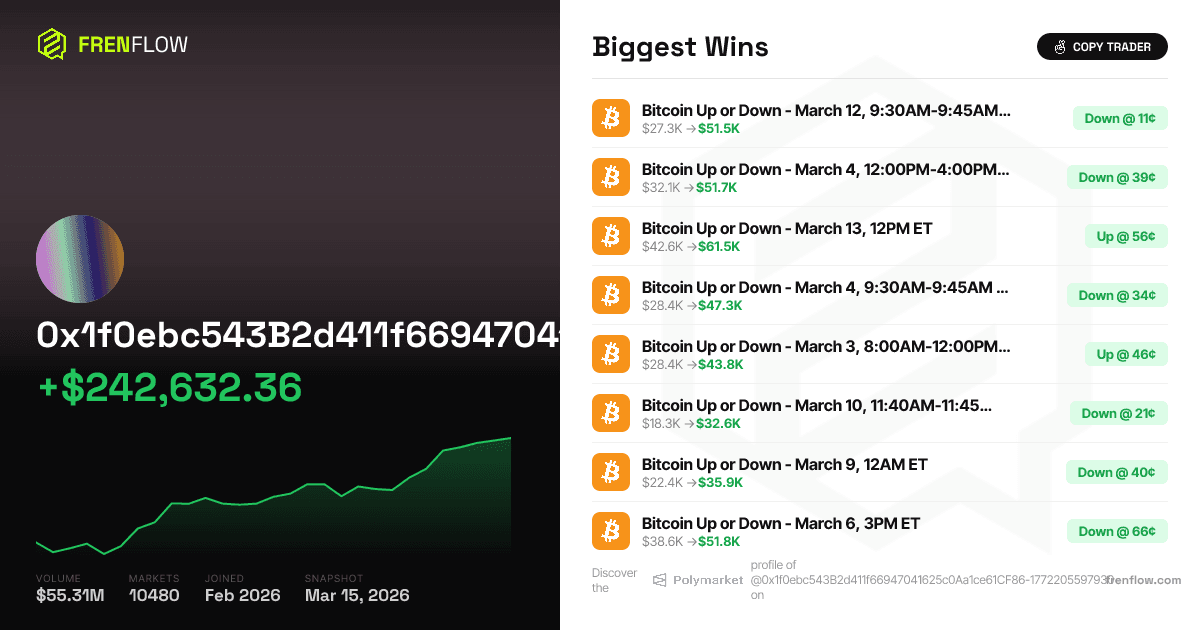
Awful-Alfalfa trades Bitcoin direction markets exclusively, focusing on timeframes that make day traders look patient. Their biggest win — a $24K profit on March 12 — came from betting $27K that Bitcoin would drop during a 15-minute window between 9:30-9:45 AM ET. Entry price: 11.4¢. The position paid out at 780% ROI.
That's not trading. That's surgical precision on market timing.
The pattern is consistent across all 50 closed positions: heavy size, short windows, extreme conviction. Average position size runs $15K-$40K, with some bets consuming 60-70% of their trading capital in a single 15-minute window.
| Market Window | Direction | Entry Price | Size | Profit | ROI |
|---|---|---|---|---|---|
| Mar 12, 9:30-9:45 AM | Down | 11.4¢ | $27K | $24K | 780.3% |
| Mar 4, 12-4 PM | Down | 38.8¢ | $32K | $20K | 157.8% |
| Mar 13, 12 PM | Up | 55.6¢ | $43K | $19K | 79.9% |
| Mar 4, 9:30-9:45 AM | Down | 33.6¢ | $28K | $19K | 197.4% |
The trade selection reveals something more interesting than luck: information asymmetry. Awful-Alfalfa consistently enters positions at prices that suggest they know something the market doesn't. Entry prices averaging 39.3¢ on winning trades means they're buying when others are selling, selling when others are buying.
The Edge Question
How does someone maintain 100% accuracy across 50 Bitcoin directional bets? Three possibilities:
Latency arbitrage: Ultra-fast execution on price discrepancies between Polymarket and spot exchanges. The 15-minute windows suggest they're playing momentum off traditional market moves.
Information flow: Access to order flow or whale movement data ahead of the crowd. The position sizing — often $25K+ on 15-minute windows — suggests high confidence in directional moves.
Market microstructure: Deep understanding of how Polymarket's AMM responds to external price pressure. They might be front-running predictable market maker adjustments.
The trade timing supports the information theory. Most wins cluster around market open (9:30 AM ET) or lunch hours (12-1 PM ET) when institutional flow typically moves Bitcoin. Their March 9 trade at 12:50-12:55 PM captured an 877% ROI on a $13K bet that Bitcoin would drop — suggesting they caught a large sell order hitting spot markets.
The Risk Trap
Perfect records hide perfect risks. Awful-Alfalfa's current open positions reveal the downside of their size-heavy approach: $38K in unrealized gains sitting alongside potential catastrophic losses.
Their current Bitcoin position for March 14, 8 AM ET shows the danger. They bought $9K worth of "Up" shares at 29.4¢. The position is now worth $15K — a $6K unrealized gain. But look at the flip side: if Bitcoin had moved down instead of up, they would have lost nearly $9K in a single hour.
The math is brutal. With an average position size of $20K and a current balance of $38K, two bad trades would wipe out 100% of their capital. Three bad trades would put them in debt.
This isn't sustainable edge — it's Russian roulette with market timing.
Pattern Recognition vs. Luck
Awful-Alfalfa's edge appears real, but fragile. Their average entry price of 39.3¢ on wins suggests they're buying when the market is roughly split on direction — classic contrarian positioning. But contrarian trades with 70% position sizing only work until they don't.
The trader's specialization in crypto-only markets makes sense from a risk perspective. Bitcoin and Ethereum move on similar macro factors, so their edge likely comes from reading traditional crypto market flow ahead of Polymarket's slower price discovery.
But specialization also means concentration risk. When crypto volatility spikes — like during March 2024's banking crisis or regulatory announcements — their entire trading capital sits exposed to single-factor risk.
The Sustainability Problem
Awful-Alfalfa has generated $539K in realized profits off $53.75M in trading volume — a 0.41% edge that's impressive for any market, let alone prediction markets. But their position sizing suggests they're optimizing for short-term gains over long-term survival.
Professional traders use position sizing rules specifically to avoid the risk Awful-Alfalfa is taking. The 2% rule — never risk more than 2% of capital on a single trade — exists because even 90% win rate strategies eventually hit losing streaks.
Awful-Alfalfa is risking 20-50% per trade. Mathematics says they will eventually lose everything.
The irony: their perfect record might be their worst enemy. Success breeds overconfidence, and overconfidence breeds position sizes that guarantee eventual ruin. They've made $539K, but they're playing with fire.
Frequently Asked Questions
How can someone have a 100% win rate on Bitcoin trades?
Awful-Alfalfa likely has access to information or execution speed that gives them an edge over Polymarket's price discovery. However, their sample size of 50 trades isn't large enough to determine if this is skill or luck — and their position sizing suggests it won't matter long-term.
What's the biggest risk in Awful-Alfalfa's strategy?
Position sizing. They're betting 20-50% of their capital on single trades, which means 2-3 losses would wipe out years of gains. Professional traders typically risk 1-2% per trade to avoid exactly this scenario.
Is this trading strategy replicable?
Unlikely. Their edge appears to come from information asymmetry or latency advantages that aren't available to retail traders. Even if the edge were replicable, the position sizing makes the strategy mathematically guaranteed to fail eventually.
How long can this perfect record last?
Mathematically, not long with their current position sizing. Even if they have a legitimate 90% win rate (extremely high), risking 30%+ per trade means they'll eventually hit a losing streak that destroys their capital. The question isn't if, but when.

Related articles

Crypto Prediction Markets: The Complete 2026 Guide
Jun 16, 2026

ohanism on Polymarket: $539K From 2.4 Million Trades on Bitcoin Candles — and Why You Can't Copy It
Jun 06, 2026

Who Is 0xde17f714…? The Anonymous Whale That Made $727K on Polymarket's Bitcoin Markets — Then Vanished
Jun 06, 2026
 Start Copying Now