

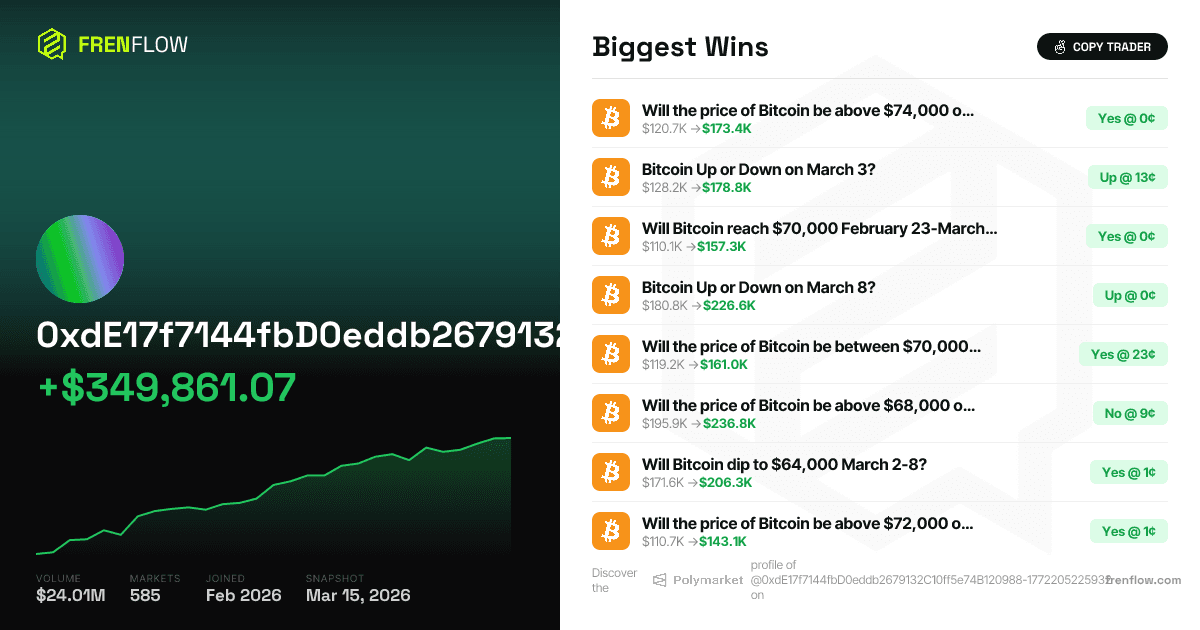
0xde17...0988Profit
+$698K
Volume
$45.8M
Attentive-Silica's 50-0 Bitcoin Streak on Polymarket
Fifty-for-Fifty at a Penny on the Dollar
An average entry price of 10.5 cents. Across 50 closed positions on Polymarket's Bitcoin markets, the trader known as Attentive-Silica has not recorded a single loss—converting $23.88M in total volume into $1.2M of realized profit from closed trades, plus another $63K in unrealized gains sitting across 15 open positions. The account, created in February 2026, has done all of this in roughly six weeks.
The numbers are jarring. But the more interesting question isn't how much this trader made. It's how—and whether the strategy that produced a perfect record contains the seeds of its own destruction.
The Deep Out-of-the-Money Playbook
Attentive-Silica's edge, if we can call it that, is a single repeated bet: buy deep out-of-the-money Yes or No shares on short-dated Bitcoin price markets, deploying six-figure position sizes, and wait for volatility to do the rest.
Consider the pattern across the top 25 trades:
| Trade | Entry Price | Position Size | Profit | ROI |
|---|---|---|---|---|
| BTC > $74K on Mar 4 | 0.4¢ | $121K | $53K | 11,150% |
| BTC > $76K on Mar 4 | 0.5¢ | $51K | $24K | 10,210% |
| BTC > $72K on Mar 3 | 0.5¢ | $42K | $21K | 9,933% |
| BTC > $66K on Mar 7 (No) | 0.1¢ | $50K | $22K | 43,592% |
| BTC reach $76K Mar 2-8 | 0.1¢ | $96K | $29K | 30,290% |
| BTC Up/Down Mar 8 (Up) | 0.1¢ | $181K | $46K | 17,018% |
| BTC dip $64K Mar 2-8 | 1.2¢ | $172K | $35K | 1,676% |
The median entry across the top 10 winners is below 2 cents. At these prices, a share costs almost nothing—but the trader is deploying $50K–$209K per position. That means buying millions of shares on each trade. "Will BTC reach $76,000 March 2–8" at 0.1¢ with a $96K outlay implies roughly 96 million shares. If the event resolves Yes (as it did), each share pays $1. The payoff is binary: total loss or a multiple of 100x or more.
This isn't conventional trading. It's structured like buying far out-of-the-money options at scale—except on Polymarket, the premiums are set by other traders, and liquidity at sub-penny prices is thin enough that a single large buyer can meaningfully move the market.
Why the Perfect Record Is Less Impressive Than It Looks
Fifty wins and zero losses. A 100% hit rate. The immediate reaction is to assume extraordinary skill. The data tells a more nuanced story.
Between late February and mid-March 2026, Bitcoin underwent precisely the kind of violent price action that makes deep OTM bets pay off. Web research confirms the timeline: Bitcoin sold off sharply when the U.S.–Iran conflict began in early March, initially falling 8.5%, then rallying roughly 11% from those lows over the following two weeks. By March 13, BTC was testing $74,000—up about 8% for the month. The asset whipsawed through $60K, $66K, $70K, $74K, and back in a matter of days.
Attentive-Silica's trades read like a map of that volatility:
- Late February: Bought "BTC dip to $62K Feb 23–Mar 1" Yes at 1.4¢ → BTC crashed. Profit: $20K.
- Early March: Bought "BTC > $68K on Mar 5" No at 0.5¢ and "BTC > $70K on Mar 5" No at 1.4¢ → BTC kept falling. Profit: $41K combined.
- Mid-March: Bought "BTC dip to $60K in March" Yes at 16¢ and "BTC > $74K on Mar 4" Yes at 0.4¢ → BTC rebounded. Profit: $96K combined.
The trader bet on violent moves in both directions—and both directions happened. In a market that moved 20%+ in a few weeks, buying penny-priced outcomes on either side of the distribution is less a directional call and more a volatility harvesting strategy. The genius isn't predicting which way Bitcoin moves. It's recognizing that Polymarket was systematically underpricing tail outcomes during a period of genuine geopolitical crisis.
The question that should trouble any analyst: would this strategy survive a month where Bitcoin traded in a 5% range? The answer is almost certainly no. Every one of these sub-penny shares would expire worthless. The 50-0 record exists because the environment—a hot war affecting global risk assets—created exactly the conditions the strategy requires.
The Portfolio Right Now: A Shift in Posture
Attentive-Silica's 15 open positions reveal a trader who has pivoted from offense to defense. The current book looks nothing like the closed trades:
| Open Position | Side | Entry | Current | Shares | Unrealized P&L |
|---|---|---|---|---|---|
| BTC dip $65K in March | No | 36.6¢ | 58.5¢ | $128K | +$28K |
| BTC dip $60K in March | No | 73.1¢ | 82.5¢ | $60K | +$6K |
| BTC dip $55K in March | No | 84.9¢ | 92.5¢ | $42K | +$3K |
| BTC dip $50K in March | No | 93.4¢ | 96.8¢ | $28K | +$950 |
| BTC > $66K on Mar 16 | Yes | 89.3¢ | 99.1¢ | $20K | +$2K |
| BTC Up/Down Mar 15 | Up | 71.7¢ | 97.3¢ | $19K | +$5K |
The average entry price across open positions is roughly 80 cents—a world apart from the 10.5-cent average on closed trades. The trader is now buying deep in-the-money shares, betting that Bitcoin will not crash to $50K, $55K, $60K, or $65K before month-end. With Bitcoin currently near $71K–$74K per the latest web data (holding above $71K as of March 14), these are high-probability bets with modest payoffs.
This shift is revealing. After six weeks of swinging for 100x returns on penny shares, Attentive-Silica is now collecting nickels and dimes on near-certain outcomes. The largest open position—$128K in "Will BTC dip to $65K" No shares—would pay about $28K if BTC stays above $65K through month-end. That's a 22% return, respectable but nowhere near the four- and five-figure ROIs on the closed book.
Two interpretations exist. The charitable one: the trader recognizes that the volatility window is closing as the Iran conflict stabilizes, and is locking in safe returns while conditions last. The less charitable one: having accumulated $1.04M in account balance, the trader is deploying capital into low-risk positions to appear active while the real edge has evaporated.
The Survivorship Problem No One Is Discussing
The profile stats contain a tell that deserves scrutiny: 581 markets traded, but a trade count of 0 and largest win of $0.00. These data artifacts likely reflect how the platform categorizes certain order types—but they also suggest the visible closed positions (50 wins) may not capture the full picture of market participation. With 581 markets touched and only 50 clean wins displayed, there may be partially filled orders, expired positions, or market-making activity that doesn't surface in the standard profit/loss ledger.
More fundamentally, we're looking at 50 trades over roughly 40 days. FrenFlow data shows the account was created in February 2026. At ~1.25 resolved trades per day, and with every single one profitable, the sample is small enough that survivorship bias is a real concern. A trader buying penny options across hundreds of markets would, by definition, only show up on anyone's radar if the environment cooperated. We don't see the parallel universe where Bitcoin traded sideways through March and Attentive-Silica bled $500K in worthless shares.
The Kelly criterion offers a useful lens. Even at a hypothetical 80% win rate with 50:1 average payoff on the penny trades, optimal position sizing would suggest risking only a few percent of bankroll per trade. Attentive-Silica routinely deployed $100K–$200K per position against a portfolio that started far smaller. This is aggressively anti-Kelly—the kind of sizing that produces spectacular results until one correlated loss wipes the portfolio. If the Iran situation had resolved overnight and Bitcoin had flatlined, several simultaneous positions would have gone to zero together.
What Happens When the Music Stops
The $348K in total profit on $23.88M in volume yields a 1.46% return on volume. For all the five-figure ROI percentages on individual trades, the aggregate picture is thin. This makes sense: many of the penny shares that resolved favorably still required enormous notional volume to generate meaningful dollar profit. The strategy is high-turnover and capital-intensive.
The current open book totals roughly $470K in deployed capital across 15 positions, with $63K in unrealized gains. If Bitcoin stays above $65K through the end of March—a scenario the market currently prices at ~59% on the "dip to $65K" market—the account stands to collect another $50K–$70K. If Bitcoin revisits the $60K–$65K range (which it touched in early March), the $128K No position on the $65K dip market alone could face a $50K+ drawdown.
Attentive-Silica's strategy worked because the market moved hard and the trader was willing to buy outcomes that the crowd dismissed. The 50-0 record is real. But it's a record compiled during the most volatile Bitcoin environment since the FTX collapse, by a trader who sizes positions as if losses aren't possible. That combination—undeniable results built on fragile assumptions—is the oldest story in trading.
Frequently Asked Questions
How much profit has Attentive-Silica made on Polymarket?
As of March 15, 2026, the trader has realized $1.2M in profit from 50 closed positions and holds approximately $63K in unrealized gains across 15 open positions. Total volume traded is $23.88M, with a current account balance of $1.04M.
What is Attentive-Silica's trading strategy on Polymarket?
The trader primarily buys deep out-of-the-money shares on short-dated Bitcoin price markets at entry prices averaging around 10.5 cents. These are essentially tail-risk bets that pay off only when Bitcoin makes large price moves—which it did repeatedly during the U.S.–Iran conflict in early March 2026.
Has Attentive-Silica ever lost a trade on Polymarket?
The trader's public record shows 50 closed positions with zero losses. However, the account has interacted with 581 markets total, and data artifacts suggest not all activity may surface in the standard win/loss tracking. The perfect record should be interpreted with this context.
How risky is Attentive-Silica's Polymarket portfolio?
Despite the perfect win record, the strategy carries substantial risk. Position sizes of $100K–$200K on penny-priced outcomes mean that a quiet month for Bitcoin—or a correlated failure across multiple positions—could produce large losses quickly. The current open book is more conservative, focused on high-probability outcomes near 80–95 cents.
Is Attentive-Silica a bot or algorithmic trader?
The trading pattern—rapid deployment across hundreds of markets, consistent position sizing, and systematic focus on Bitcoin price outcomes—is consistent with algorithmic execution. The account has no linked social media, no bio, and an auto-generated pseudonym, which is typical of programmatic Polymarket accounts.

 Start Copying Now